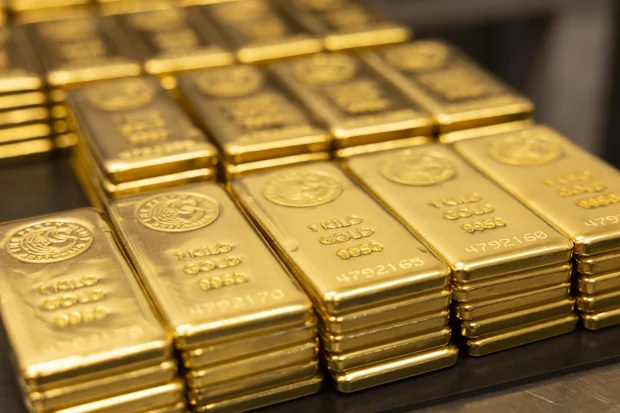
Gold prices moved higher in Asian trading on Tuesday, reclaiming levels above the key $5,000 mark as investors focused on oil market movements, the ongoing U.S.-Israel-Iran conflict, and a series of major central bank meetings scheduled for this week.
The precious metal had briefly slipped below $5,000 per ounce in the previous session but rebounded as easing oil prices helped reduce concerns about the inflationary impact of the conflict. Spot gold rose 0.6% to $5,035.62 per ounce, while gold futures gained 0.8% to $5,039.94.
Despite the recovery, gold continues to trade within a relatively tight range between $5,000 and $5,200 per ounce, a pattern that has persisted over the past three weeks. Market sentiment remains mixed, with safe-haven demand supporting prices, while inflation concerns linked to the conflict limit further upside.
Other precious metals also posted gains. Platinum increased 1.9% to $2,156.27 per ounce, and silver advanced 1% to $81.785 per ounce. However, similar to gold, both metals have largely moved sideways after pulling back from record highs reached earlier this year.
Investor attention is now turning to a busy week for global central banks. The Federal Reserve is set to announce its policy decision on Wednesday and is widely expected to keep interest rates unchanged amid uncertainty surrounding inflation.
Additional meetings are scheduled for the Bank of Canada, Bank of Japan, Swiss National Bank, Bank of England, and the European Central Bank, with markets closely watching for signals on inflation and future rate direction.
Rising energy prices driven by geopolitical tensions have heightened fears of persistent global inflation. This has increased expectations that central banks may maintain a more hawkish stance, potentially keeping interest rates elevated for longer.
Higher interest rates typically weigh on non-yielding assets like gold, as they reduce the metal’s attractiveness compared to interest-bearing investments. Earlier in 2026, gold’s strong rally toward record highs near $5,600 per ounce was largely driven by expectations of lower interest rates.