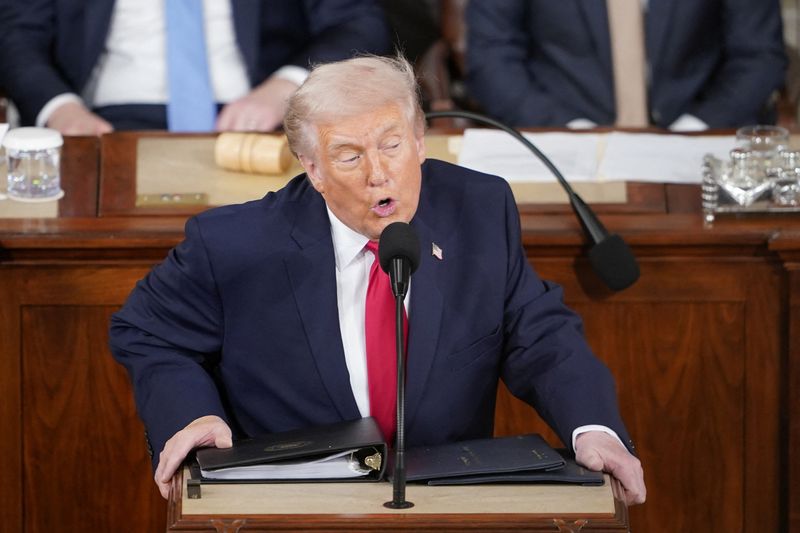
President Donald Trump addressed a joint session of Congress on Tuesday in his State of the Union speech, a key political moment as the White House works to strengthen Republican support ahead of the November midterm elections.
The speech came amid heightened tensions with Iran and growing voter dissatisfaction over the rising cost of living. Below are the main takeaways from Trump’s address.
Economy Front and Center
The U.S. economy dominated Trump’s speech. After weeks of pressure from advisers to focus more on economic issues, the president placed jobs, inflation and household costs at the core of his message.
Trump discussed a wide range of everyday concerns, including housing, healthcare, energy bills, crime and retirement security. However, he stopped short of fully acknowledging that many Americans continue to struggle with high food and housing prices.
He defended his healthcare proposals aimed at lowering drug prices and providing direct federal payments to citizens, arguing they would reduce overall costs. Trump also reiterated that tariffs previously struck down by the U.S. Supreme Court were generating revenue and are being reinstated under different legal authority.
Despite his optimistic tone — claiming inflation, mortgage rates and gasoline prices are falling while stock markets and oil production are rising — official data shows inflation increased last year and job growth remained modest. Public opinion surveys indicate continued concern about economic conditions, with a majority of voters expressing dissatisfaction with his handling of the economy.
Political Theater and Symbolism
Although more disciplined than in some past appearances, Trump incorporated highly visual and symbolic moments into his speech.
He awarded honors to Korean War Navy pilot E. Royce Williams and Team USA hockey goaltender Connor Hellebuyck. Army Chief Warrant Officer Eric Slover also received a Medal of Honor. Several invited guests were publicly recognized, including Erika Kirk, widow of conservative activist Charlie Kirk.
These moments highlighted how State of the Union addresses have evolved into a blend of policy messaging and political spectacle. Trump emphasized patriotism and presented Olympic athletes as evidence that America is “winning” again.
Other guests were introduced to support his positions on immigration and education policy, reinforcing themes that have featured prominently in his political messaging.
Limited Detail on Iran and Foreign Policy
One of the key questions ahead of the speech was whether Trump would present a detailed case for potential military action against Iran.
While he eventually addressed Iran, the discussion was brief and largely repeated familiar points about preventing Tehran from acquiring nuclear weapons and countering regional instability. He did not outline a specific military strategy or timeline.
Russia, Ukraine and Venezuela received minimal attention, and there was no mention of previous proposals involving Greenland or the Panama Canal. The relatively limited focus on foreign policy marked a shift compared with earlier addresses.
Immigration Strategy Reframed
Immigration was another major theme. Trump attempted to regain control of the narrative after recent controversies surrounding enforcement policies.
He highlighted crimes committed by immigrants and argued that Democrats could not be trusted to secure U.S. borders. However, he did not mention specific enforcement agencies such as Border Patrol or Immigration and Customs Enforcement.
The president sought to redirect attention toward aspects of immigration policy that have resonated strongly with his voter base in the past, while avoiding discussion of the most controversial elements of recent deportation efforts.
Shifting Priorities Ahead of Midterms
Compared with last year’s address, Trump’s latest speech reflected changing priorities. Several foreign policy ambitions previously emphasized were absent, including discussions about Greenland and China.
He also did not highlight Elon Musk or the Department of Government Efficiency, instead announcing a new anti-fraud initiative led by Vice President JD Vance.
In addition to economic proposals, Trump renewed calls for election law reforms ahead of the midterm elections, including voter identification requirements and restrictions on mail-in ballots.
Sharp Partisan Divide
Trump urged voters to extend Republican control of Congress, arguing that his party’s approach to the economy, immigration and public safety justifies continued leadership.
He criticized Democratic lawmakers in strong terms, accusing them of undermining the country. The speech underscored the deep partisan divide in Congress, with Republicans frequently applauding while Democrats largely remained seated and, in some cases, openly challenged the president during the address.
Overall, Trump’s State of the Union speech focused heavily on the economy and immigration while offering fewer details on foreign policy, as he sought to consolidate political support ahead of the upcoming elections.