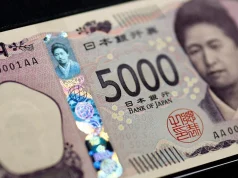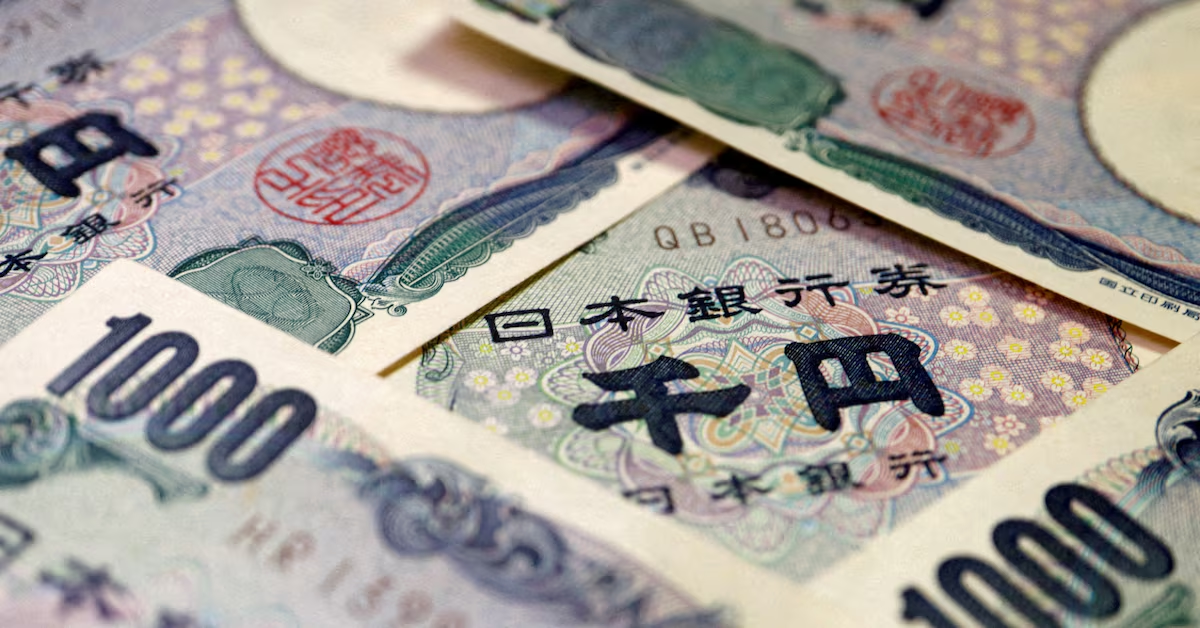
The Japanese yen remained under pressure on Wednesday, trading close to a two-week low after reports that Prime Minister Sanae Takaichi expressed reservations about further interest rate hikes. At the same time, a steadily strengthening Chinese yuan continued to weigh on the U.S. dollar.
Market participants in Asia also focused on U.S. President Donald Trump’s State of the Union address. Meanwhile, the Australian dollar climbed 0.3% to $0.7074 after fresh inflation data increased expectations of potential rate hikes, making it the strongest performer in an otherwise calm trading session.
The euro traded around $1.1776, while the British pound hovered near $1.35. The yen had fallen 0.8% overnight to 156.28 per dollar before recovering slightly to 155.88.
Takaichi Report Raises BOJ Policy Concerns
According to the Mainichi newspaper, Prime Minister Sanae Takaichi voiced concerns last week about additional rate increases during a meeting with Bank of Japan Governor Kazuo Ueda. The report, which cited unnamed sources, sparked speculation about possible tensions between the government and the central bank.
If confirmed, the remarks could complicate the Bank of Japan’s gradual tightening strategy. Investors worry that political resistance to higher rates may prolong Japan’s ultra-loose monetary policy and contribute to further yen weakness.
Bob Savage, head of markets macro strategy at BNY, noted that Takaichi’s reportedly tougher stance surprised markets and increased concerns over foreign exchange volatility and potential policy shifts that could be viewed as unfriendly to investors.
He added that coordinated intervention with the United States may act as a barrier against the yen weakening toward the 160 level and help limit excessive currency swings.
Questions Over Currency Intervention
Separately, the Nikkei newspaper reported that the United States conducted “rate checks” in January that supported the yen. This development has raised questions about how committed Japanese authorities are to defending their currency.
The yen has faced sustained pressure in recent years due to Japan’s low interest rate environment. Since Takaichi took office in October, concerns have grown that continued fiscal expansion and low borrowing costs could further strain Japan’s national budget and weaken the currency.
Chinese Yuan Strengthens as Tariff Outlook Eases
Elsewhere in the Asia-Pacific region, the New Zealand dollar edged higher to $0.5971. The Chinese yuan remained firm after posting its strongest one-day gain in nine months, rising 0.35% on Tuesday.
The U.S. Supreme Court’s recent decision to strike down several of President Donald Trump’s most significant tariffs could result in lower overall duties on Chinese goods, analysts said. This development may pave the way for additional yuan appreciation.
The yuan, which has gained nearly 7% over the past ten months, reached 6.8766 per dollar on Tuesday — its highest level in almost three years — and held near 6.8778 in offshore trading.
Analysts at Goldman Sachs said the fundamental drivers supporting yuan appreciation remain intact, including what they describe as deep currency undervaluation and strong export performance. While uncertainties persist, they believe the likelihood of new Section 301 tariffs before President Trump’s planned visit to China at the end of March remains low.