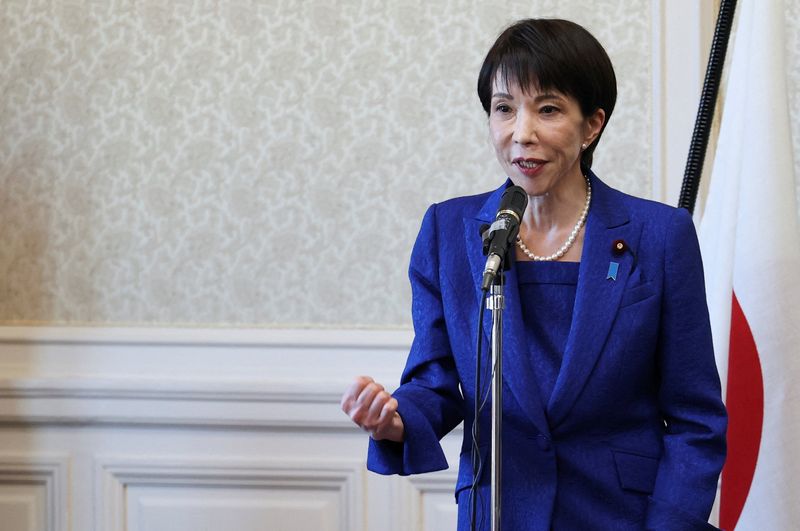
Japan’s ruling party, led by Prime Minister Sanae Takaichi, is on course for a landslide victory in next week’s lower house election, according to a poll published by the Asahi Shimbun. The result would strengthen expectations that Japan will continue pursuing aggressive government spending and tax cuts.
A decisive win in Sunday’s vote would reinforce Takaichi’s leadership within her party and provide a strong mandate for expansionary fiscal policies. Such an outcome could reignite concerns over Japan’s public finances and place upward pressure on government bond yields.
Ryutaro Kono, chief Japan economist at BNP Paribas, warned that implementing large-scale fiscal stimulus while the economy is near full employment could increase inflationary pressures and weaken the yen.
Kono added that the Bank of Japan may be forced to raise interest rates more quickly to counter rising inflation and currency weakness driven by looser fiscal policy.
According to the poll, Takaichi’s Liberal Democratic Party is expected to comfortably surpass the 233-seat majority threshold in the 465-seat lower house, rising from its current 198 seats. When combined with coalition partner Ishin, the ruling bloc could secure around 300 seats.
Meanwhile, the main opposition party, the Centrist Reform Alliance, is projected to suffer heavy losses and could lose up to half of its current 167 seats.
Super-long Japanese government bond yields rose on Monday, reflecting investor concerns that a strong election mandate would allow Takaichi to press ahead with her “proactive” fiscal agenda centred on higher spending and tax relief.
The yen also came under pressure following comments by Takaichi over the weekend that highlighted the benefits of a weaker currency. Her remarks were interpreted by markets as tolerating yen depreciation, at odds with previous efforts by officials to stabilise the currency.
“Many say the weak yen is a problem, but for export-oriented industries it represents a major opportunity,” Takaichi said, adding that a weaker currency boosts the value of Japan’s substantial foreign reserves.
A government spokesperson later clarified that Takaichi was not promoting yen weakness, but rather emphasising the need for an economy that can withstand currency fluctuations.
The weak yen remains a challenge for policymakers, as it raises import costs and contributes to broader inflation pressures.
Fiscal risk concerns seen as overstated
Takaichi’s coalition currently holds only a narrow majority in the lower house and lacks control of the upper house. She dissolved parliament last month and called a snap election for February 8 to seek public backing for her reflationary economic strategy.
Markets were rattled last month after Takaichi proposed suspending an 8% levy on food sales for two years, reviving fears over fiscal discipline in a country with public debt exceeding twice the size of its economy.
Several political parties have also advocated suspending or cutting consumption taxes to ease pressure on households facing rising living costs.
Some analysts argue that a strong victory for the Liberal Democratic Party could actually limit the likelihood of more extreme spending or tax proposals from opposition groups.
The ruling party has not specified when a potential tax suspension might be implemented, saying the issue should be discussed jointly with opposition lawmakers.
In its election platform, the LDP reaffirmed its commitment to lowering Japan’s debt-to-GDP ratio and advancing both spending and revenue reforms, according to Takeshi Yamaguchi, chief Japan economist at Morgan Stanley MUFG Securities.
Yamaguchi said concerns over Japan’s fiscal position remain exaggerated and that fears of a debt crisis are misplaced.