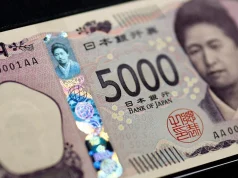
The Japanese yen experienced sharp volatility on Friday, with two abrupt upward moves fueling speculation that authorities may have conducted a so-called rate check, a step often seen as a signal ahead of possible market intervention.
The currency was last trading stronger on the day at 156.495 per dollar, after briefly touching 156.19 earlier in the session.
Market participants remain highly alert to the risk of intervention from Tokyo, particularly after the yen weakened to around 159.2 per dollar—near an 18-month low—during a press briefing by the Bank of Japan governor, following the central bank’s decision to keep interest rates unchanged.
According to Marc Chandler, chief market strategist at Bannockburn Capital Markets, the move appeared to be driven less by concrete news and more by persistent bearish sentiment combined with growing fears of official action.
Shortly after the press conference, the yen strengthened suddenly to around 157.3 per dollar. However, the prevailing view in the market was that authorities had not directly intervened, but instead carried out rate checks with financial institutions.
A rate check involves officials asking banks at what price they could intervene, and is commonly used as a warning signal that policymakers are prepared to step into the market if needed.
Erik Bregar, director of FX and precious metals risk management at Silver Gold Bull, noted that uncertainty late in the week and a lack of clear direction had added to market anxiety, amplifying the size of the move.
The yen has remained under sustained pressure since October, falling more than 4% amid mounting fiscal concerns and lingering near levels that have previously triggered verbal warnings and intervention speculation.
Investor nerves were further highlighted this week by sharp moves in Japan’s bond market. A selloff pushed government bond yields to record highs after a snap election was called for February alongside promises of tax cuts. While yields have since eased, market sentiment remains fragile.
Dollar selling gathers pace
Beyond Japan, the U.S. dollar was on track for its steepest weekly decline since June, as geopolitical developments unsettled global markets.
The greenback came under pressure after comments from U.S. President Donald Trump regarding a NATO-backed agreement involving Greenland, alongside a retreat from earlier tariff threats against Europe and assurances that force would not be used against the Danish autonomous territory.
At the start of the week, U.S. assets were heavily sold as geopolitical tensions escalated, reviving discussion of a broader “Sell America” trade that first gained traction following sweeping trade measures announced last April.
The dollar index, which tracks the U.S. currency against six major peers, was last seen at 97.876 and was headed for a weekly loss of more than 1%, its largest drop since June.
The euro rose 0.2% to $1.1779 and was set for a weekly gain exceeding 1%. In France, political uncertainty persisted after the government survived two no-confidence votes, with further challenges expected following the use of constitutional powers to push through part of the 2026 budget.
Sterling traded at $1.35921. Although UK retail sales unexpectedly rose in December, the data had limited impact on the pound.