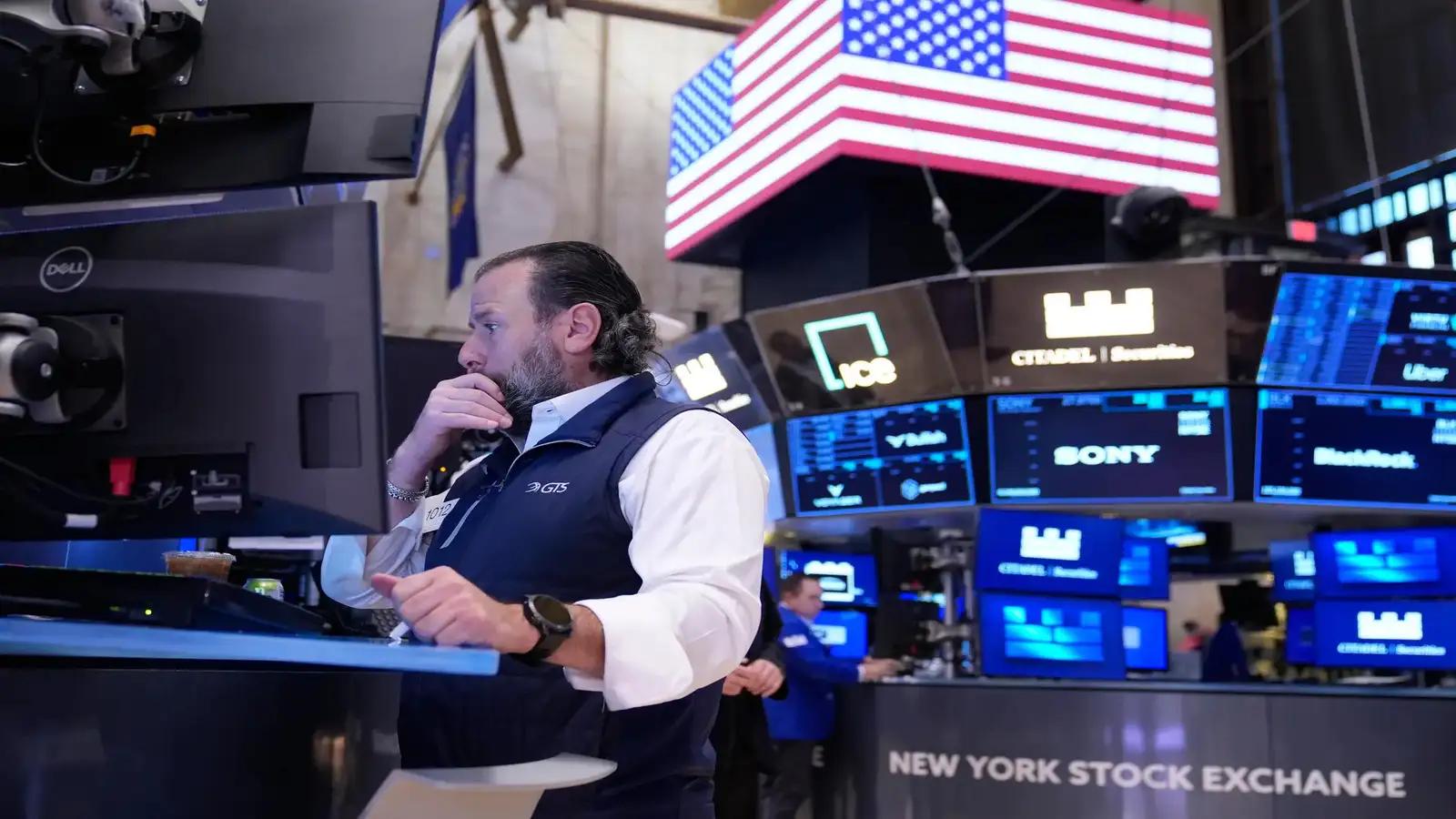
U.S. stocks moved higher on Thursday, rebounding after two consecutive sessions of losses as investors focused on geopolitical developments and a fresh round of earnings from the banking sector.
By 09:32 ET (14:32 GMT), the Dow Jones Industrial Average was up 100 points, or 0.2%, the S&P 500 added 0.6%, and the NASDAQ Composite jumped 0.9%.
Geopolitics back in focus
Geopolitical risks remained front and center after U.S. President Donald Trump expressed confidence that an agreement on Greenland could be reached, following high-level talks between U.S., Danish, and Greenlandic officials.
“I think something will work out,” Trump said, even as Denmark’s foreign minister Lars Lokke Rasmussen acknowledged a “fundamental disagreement” with Washington after meetings at the White House.
The comments followed discussions involving Secretary of State Marco Rubio and Vice President JD Vance.
Tensions linked to Iran also appeared to ease. Trump said he had been informed that killings tied to Iran’s crackdown on protests were declining and that there was no current plan for large-scale executions. His remarks came after earlier fears that the U.S. could intervene militarily following repeated threats to act in support of Iranian protesters.
Trump addresses Fed leadership concerns
Investor sentiment was further supported after Trump said he had “no plan” to dismiss Jerome Powell, despite the Justice Department opening a criminal investigation into the Federal Reserve chair. Speaking to Reuters, Trump added that it was “too early” to determine what action he might take.
Powell’s disclosure that he had received a subpoena from the Justice Department has raised fresh concerns over the Federal Reserve’s independence and its ability to conduct monetary policy without political pressure.
Labor data and earnings in focus
Economic data released earlier Thursday showed that initial claims for unemployment benefits fell unexpectedly to a seasonally adjusted 198,000 in the week ended January 10, compared with a downwardly revised 207,000 the week before. Economists had expected claims to rise to around 215,000.
Recent indicators suggest a gradual cooling in the U.S. labor market, with limited hiring and layoffs amid an uncertain economic outlook. At the same time, rising productivity points to companies extracting more output from existing workforces rather than expanding headcount.
In corporate news, the banking sector remained in the spotlight. Morgan Stanley reported a sharp increase in fourth-quarter profit, helped by a surge in dealmaking activity. Goldman Sachs also posted stronger quarterly earnings, supported by robust trading revenue, active dealmaking, and a one-off gain from exiting its credit card partnership with Apple.
These results followed earnings from other major lenders, including JPMorgan Chase and Bank of America, and are being closely watched as indicators of the broader health of the U.S. economy and corporate sector early in 2026.
Elsewhere, Taiwan Semiconductor Manufacturing reported better-than-expected fourth-quarter net profit, driven by strong demand for advanced processors fueled by artificial intelligence. The company is widely seen as a bellwether for the global semiconductor industry.
Trump announced 25% tariffs on some advanced computing chip imports on Wednesday, though the measures are unlikely to significantly impact major producers due to their manufacturing presence in the United States.
Oil prices fall sharply
Oil prices dropped sharply on Thursday, ending a five-day rally after Trump signaled a more restrained approach toward Iran, easing concerns about potential supply disruptions.
Brent crude futures fell 4.1% to $63.79 a barrel, while U.S. West Texas Intermediate crude slid 4.3% to $59.38 a barrel. Prices had risen more than 10% over the previous five sessions on fears that unrest in Iran could trigger U.S. military action and disrupt oil production or shipping routes.