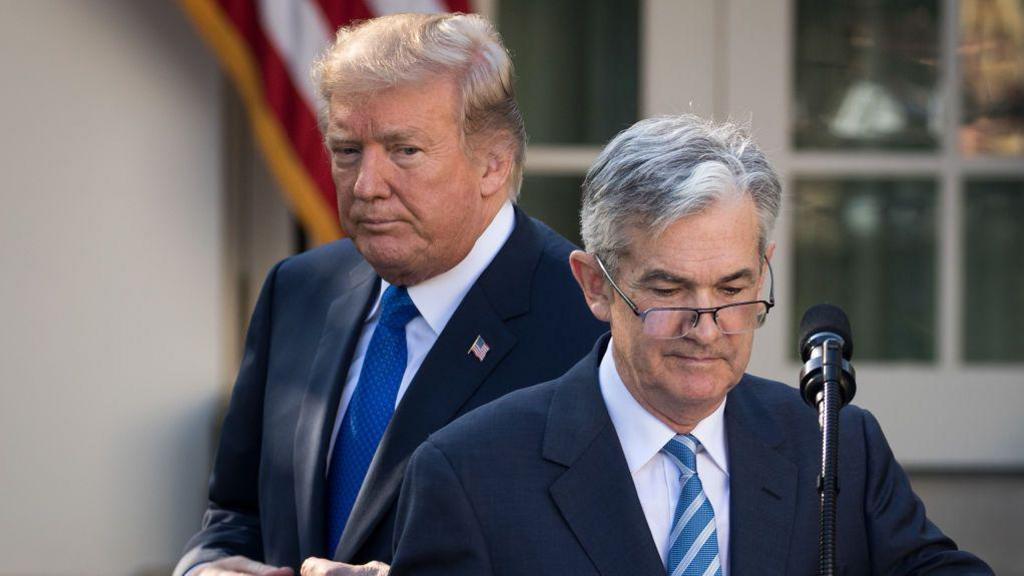
Global central bank leaders and senior Wall Street bank executives publicly rallied behind Jerome Powell on Tuesday, underscoring broad support for the Federal Reserve chief after the Trump administration threatened him with a potential criminal indictment. Powell described the move as an attempt to intimidate the U.S. central bank.
The strong reaction highlighted both the international relationships Powell has cultivated during his tenure and the central role the Federal Reserve plays in global financial stability. It followed resistance on Monday from several Republican lawmakers aligned with Donald Trump, including members of the Senate Banking Committee, who hold the authority to block any attempt to replace Powell with a more compliant successor.
Powell’s current term is set to expire in May. Late on Sunday, he disclosed that the Fed had received subpoenas from the U.S. Department of Justice related to statements he made to Congress about a $2.5 billion renovation of the Fed’s Washington headquarters. Powell said the investigation was being used as leverage to pressure the central bank into cutting interest rates, something Trump has repeatedly demanded.
“We stand in full solidarity with the Federal Reserve System and its Chair Jerome H. Powell,” the leaders of 11 of the world’s largest central banks said in a rare joint declaration.
Support also came from the private sector. Jamie Dimon, chief executive of JPMorgan Chase, warned that political interference could backfire. Speaking on a conference call, he said the probe could ultimately lift inflation expectations and push interest rates higher rather than lower.
Central bank independence has long been regarded as a cornerstone of modern monetary policy. That principle remained largely unquestioned until Trump began publicly calling for lower rates and criticizing policymakers who resisted those demands.
On Tuesday, Trump again urged Powell to cut rates “meaningfully” after official data showed U.S. consumer prices rose 2.7% year over year in December. The president was also scheduled to visit a Ford truck plant in Detroit to highlight domestic manufacturing and his administration’s efforts to address high living costs. Despite the pressure, traders continued to price in expectations that persistent inflation would keep the Fed on hold until at least June.
Unprecedented backing from global peers
Central bank heads from the European Central Bank, the Bank of England, the Bank of Canada, and several other institutions said Powell had acted with integrity and stressed that central bank independence is vital for price stability and orderly markets.
“The independence of central banks is a cornerstone of price, financial and economic stability in the interest of the citizens we serve,” the joint statement said.
Additional signatories included central bank leaders from Sweden, Denmark, Switzerland, Australia, South Korea, Brazil and France, along with senior officials from the Bank for International Settlements.
Many policymakers fear that political pressure on the Fed would weaken confidence in its commitment to controlling inflation, potentially triggering higher prices and increased volatility across global markets. Others worry that a politicized Fed could undermine its role as a dollar liquidity backstop for financial institutions worldwide, a mechanism traditionally used to stabilize markets during periods of stress.
Such a shift could unsettle U.S. financial markets, drive domestic inflation higher, and transmit instability abroad through global capital flows, making it harder for other central banks to maintain price stability at home.
“Independent central banks that can set monetary policy in the long-term interest of the country have proven their value over decades,” said Robin Vince, chief executive of BNY Mellon. He cautioned against undermining confidence in the Fed, warning that doing so could ultimately push interest rates higher rather than lower.