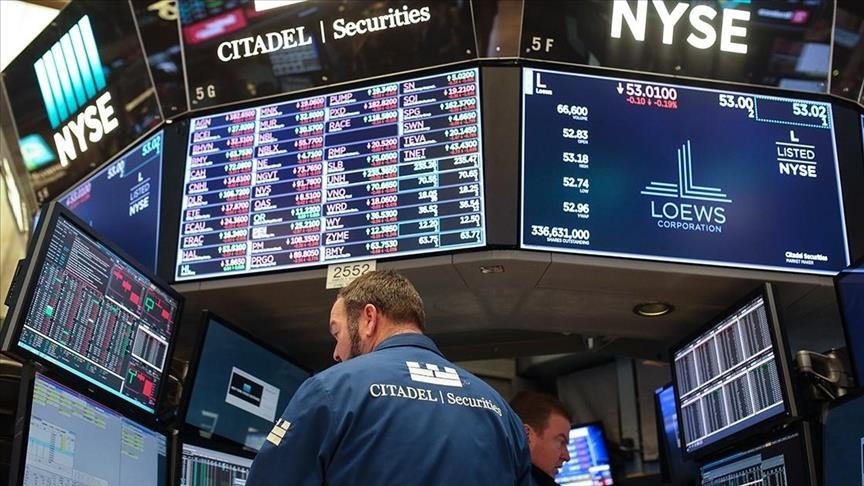
U.S. stocks moved higher on Friday as investors absorbed a closely watched monthly employment report and noted that the Supreme Court of the United States would not issue a ruling on the legality of President Donald Trump’s global tariff policy during the session.
By 10:32 ET (15:32 GMT), the Dow Jones Industrial Average was up 189 points, or 0.4%. The S&P 500 gained 35 points, or 0.5%, while the Nasdaq Composite rose 160 points, or 0.7%.
Major indexes were also on track to finish the week in positive territory. The S&P 500 was up roughly 0.9% for the week, while the Dow and Nasdaq had gained about 1.8% and 1.1%, respectively, ahead of Friday’s session.
December jobs report sends mixed signals
The U.S. economy added 50,000 jobs in December, slowing from 56,000 in November, according to data released by the Bureau of Labor Statistics. Economists had been expecting job growth of around 66,000.
Payroll figures for November were also revised lower from an initial estimate of 64,000. Meanwhile, October’s job losses were revised down by 68,000 to a decline of 173,000.
Taking these revisions into account, total employment for October and November was 76,000 lower than previously reported. The BLS said the changes reflected updated information from businesses and government agencies, as well as revised seasonal adjustments.
Despite softer job creation, the U.S. unemployment rate edged down to 4.4%, compared with expectations that it would remain at November’s revised level of 4.5%.
Analysts at Vital Knowledge said the data support the view of a gradually improving economy, but not one strong enough to force the Federal Reserve into a sharply more hawkish stance.
Investors continue to watch labor market data closely, as it plays a key role in shaping expectations for interest rate policy. The Federal Reserve cut rates several times last year to support a cooling labor market, even as inflation remained sticky. Markets are currently pricing in two additional 25-basis-point rate cuts in 2026.
Supreme Court holds off on tariffs decision
Elsewhere, the Supreme Court declined to issue a ruling on Friday regarding Trump’s use of emergency economic powers under a 1977 law to impose global tariffs. During hearings in November, justices across the ideological spectrum expressed skepticism about the administration’s legal justification.
If the tariffs were ultimately overturned, the U.S. government could face refund claims totaling an estimated $150 billion for duties already paid by importers.
Oil prices climb toward another weekly gain
Oil prices also rose on Friday and were on track for a third consecutive weekly gain, as geopolitical developments in Venezuela and Iran fueled concerns about potential supply disruptions.
Brent crude futures climbed 2.2% to $63.36 per barrel, while West Texas Intermediate crude rose 2.6% to $59.25.
Both benchmarks jumped more than 3% on Thursday after two days of losses, putting them on pace for weekly gains of around 2%.
Unrest in Iran, a major Middle Eastern oil producer, has heightened supply concerns, following the Trump administration’s seizure of Venezuelan President Nicolas Maduro last week and claims that Washington will oversee Venezuela’s oil sector.
President Trump said he plans to meet with executives from several major oil companies on Friday to discuss the future of Venezuela’s vast oil reserves.