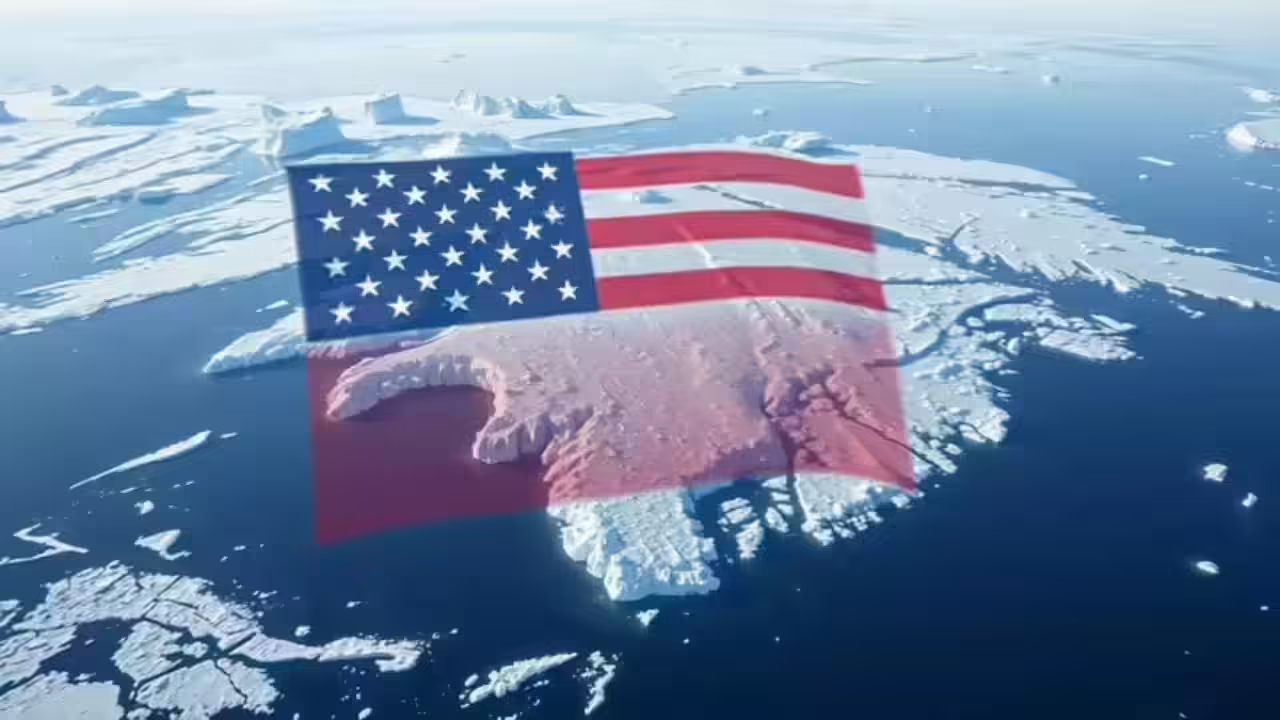
Despite repeated statements from Denmark that Greenland is not for sale, U.S. President Donald Trump and his advisers have been discussing what a hypothetical purchase of the territory might look like, according to comments made this week by a White House spokesperson.
Even as a purely theoretical exercise that assumes Denmark’s willingness to sell, the idea of placing a monetary value on an autonomous territory like Greenland quickly runs into major conceptual and practical obstacles.
“There is no market for buying and selling countries,” said Nick Kounis, noting that no accepted framework exists for valuing sovereign or semi-sovereign states.
Why History Offers No Clear Price Guide
Looking to historical precedents provides little clarity. In 1946, the United States offered Denmark $100 million for Greenland — an offer Copenhagen rejected. Adjusted for inflation, that sum would equal roughly $1.6 billion today, a figure widely seen as meaningless given the massive expansion of both the U.S. and Danish economies over the past eight decades.
Other landmark acquisitions, such as the U.S. purchase of Louisiana from France in 1803 or Alaska from Russia in 1867, also fail as comparisons. In both cases, the sellers were willing participants, and any modern valuation would depend heavily on assumptions around inflation, land appreciation, and regional economic growth — variables that are impossible to standardize.
Could Greenland Be Valued Like a Company?
Applying a corporate-style valuation based on income generation also proves problematic. According to Denmark’s central bank, Greenland’s fishing-driven gross domestic product stood at just $3.6 billion in 2023 — roughly one-tenth the size of Iceland’s economy.
Even if GDP were used as a starting point, determining an appropriate valuation multiple would be highly subjective. Complicating matters further, Denmark provides subsidies that fund about half of Greenland’s public spending, including healthcare, education, and infrastructure. Any buyer would need to factor in the cost of replacing that support.
Mineral Wealth Comes With Heavy Constraints
While Trump has publicly denied targeting Greenland’s mineral or energy resources, Reuters reported in October that his administration discussed taking a stake in Critical Metals Corp, which aims to develop what could become the island’s largest rare earths project.
Estimates suggest Greenland’s mineral and energy reserves could be worth hundreds of billions of dollars. A 2023 survey found that 25 of the 34 materials classified as “critical raw materials” by the European Commission are present on the island.
However, major hurdles remain. Oil and gas extraction are banned for environmental reasons, while mining projects face extensive regulatory barriers and opposition from Indigenous communities. Any prospective buyer would have to decide whether — and how much — to discount for these political and social constraints.
Another fundamental issue is that resource deals do not involve the transfer of sovereignty. Greenland’s Inuit population also asserts its own historical and cultural claims, adding an intangible dimension that cannot be priced.
“Once you factor in Indigenous culture, history, and identity, valuation becomes impossible,” said Andreas Osthagen of Norway’s Fridtjof Nansen Institute. “There is simply no way to put a price on that.”
Strategy, Leverage, and Security Concerns
For now, the Trump administration has said all options remain on the table — including military measures — to secure control over territory it deems critical to U.S. national security. The United States already maintains a limited military presence in Greenland.
U.S. Secretary of State Marco Rubio is scheduled to meet Danish officials next week, potentially offering more insight into Washington’s strategy.
Kounis suggested the Greenland discussion may mirror Trump’s negotiating tactics in other areas, such as trade disputes, where extreme proposals are floated to gain leverage.
“If the end goal is a settlement that advances U.S. military or economic interests,” he said, “then this could be about shaping future negotiations rather than an actual purchase.”