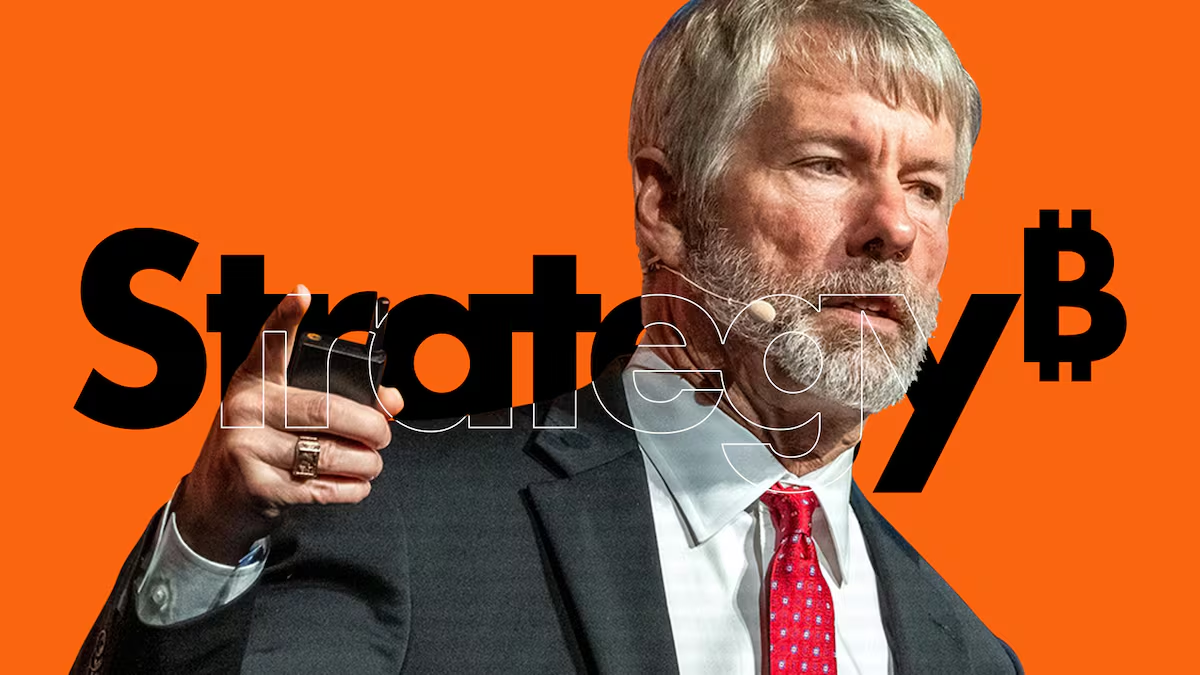
Strategy Buys 22,000+ Bitcoin as RWAs Surpass $19B in December
Bitcoin ended the year under pressure, but that didn’t stop aggressive accumulation from some of the market’s largest players. While prices slipped in December, institutional activity, legal battles in prediction markets, rising crypto crime, and explosive growth in tokenized real-world assets defined the final month of the year.
Here’s a breakdown of December’s most important crypto developments.
Strategy Adds Over 22,000 Bitcoin in a Single Month
Despite a weakening Bitcoin market, **Michael Saylor’s company Strategy continued buying at scale. During December alone, the firm acquired 22,628 BTC, according to its public disclosures.
That brings Strategy’s total Bitcoin holdings to 672,497 BTC, representing roughly 3.3% of the nearly 19.9 million Bitcoin currently in circulation.
December’s purchases capped off an exceptionally active year. Strategy reported Bitcoin acquisitions in 41 different weeks during 2025, more than double the number in 2024 and far above activity levels seen in 2023.
The firm’s ability to raise debt to fund Bitcoin purchases has helped popularize the idea of “Bitcoin treasury companies.” Data from BitcoinTreasuries.net shows 192 public companies now hold close to 1.1 million BTC collectively on their balance sheets.
Bitcoin Falls 4% Heading Into Year-End
Bitcoin’s price declined more than 4% in December, trading near $88,000 at the time of publication. The asset is on track to close the year below its January levels and well under its October peak of $126,000.
Some market participants warn that if Bitcoin’s historical four-year cycle remains intact, prices could still face deeper downside. Others argue that growing institutional participation has fundamentally changed market dynamics.
Nick Ruck, director at LVRG Research, previously noted that demand from ETFs and corporate treasuries may be cushioning the downturn. He suggested that while short-term consolidation is likely, the broader bull market could extend into 2026, supported by structural inflows and evolving market conditions.
Prediction Markets Clash With Regulators in 11 U.S. States
Prediction markets made significant progress in the U.S. during December. Early in the month, CNBC announced a partnership with Kalshi, integrating real-time forecasting data across its platforms.
However, regulatory pushback quickly followed. Authorities in 11 states have now taken legal action against prediction market operators, arguing that these platforms offer unlicensed gambling products.
Kalshi has received cease-and-desist orders in states including New York, Illinois, Ohio, Arizona, and Montana. Regulators claim the platform is operating outside state gambling laws—an accusation the company firmly rejects.
In Massachusetts, prosecutors argue that Kalshi is disguising sports betting as financial “event contracts.” Kalshi maintains that its offerings are fundamentally different from traditional sportsbooks and says it has filed suit in federal court to defend its model.
Crypto Hacks Total $22.5M in December
Crypto-related exploits resulted in $22.5 million in losses during December across ten separate incidents, according to DefiLlama data. While relatively low compared with earlier months, the figure contributes to an alarming annual total.
Blockchain analytics firm Chainalysis estimates that crypto thefts reached $3.4 billion in 2025. The firm highlighted a sharp rise in attacks targeting personal wallets, which now account for a much larger share of stolen funds than in previous years.
Large-scale breaches also played a major role. In February, hackers stole $1.4 billion from the Bybit exchange alone. Chainalysis noted that cybercriminal groups linked to North Korea were responsible for approximately $2.02 billion in crypto theft this year.
RWAs Climb Past $19B, Overtake DEXs in DeFi Rankings
Tokenized real-world assets continued their rapid ascent in December. Total distributed asset value for RWAs rose 3%, pushing the category beyond $19 billion.
Tokenized U.S. Treasurys dominate the sector at $8.7 billion, followed by commodities at $3.5 billion. According to DefiLlama, RWAs are now the fifth-largest asset category in DeFi by total value locked, surpassing decentralized exchanges.
Much of this growth is being driven by tokenized fund products such as BlackRock’s BUIDL, Circle’s USYC, Franklin Templeton’s BENJI, and Ondo’s OUSG.
Vincent Liu, chief investment officer at Kronos Research, previously noted that the biggest constraint facing RWAs is no longer tokenization itself, but liquidity and deeper integration with traditional finance systems.