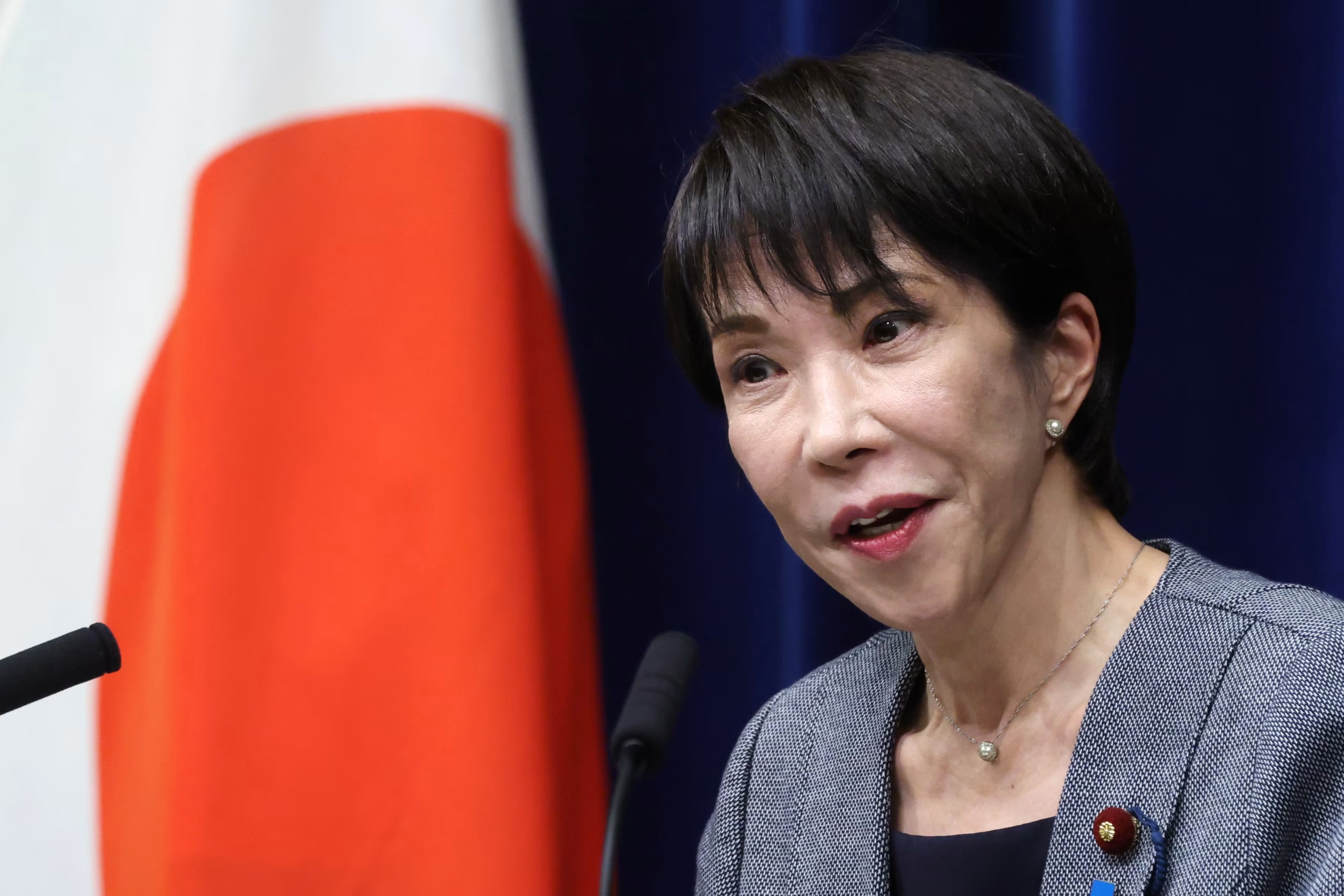
Japan’s government on Friday proposed a record budget for the next fiscal year, while taking steps to restrain new debt issuance, highlighting the delicate policy challenge facing Prime Minister Sanae Takaichi. The plan aims to support economic growth at a time when inflation remains above the central bank’s target and financial markets remain sensitive to fiscal expansion.
Takaichi’s cabinet approved a draft budget worth $783 billion, designed to calm investor concerns by capping government bond issuance and cutting the share of spending financed by new debt to its lowest level in nearly 30 years. The move comes as Tokyo core inflation continues to run above the Bank of Japan 2% target, while the yen remains weak—factors that strengthen the case for further interest rate hikes.
The proposed 122.3 trillion yen budget for the fiscal year starting in April is a cornerstone of Takaichi’s “proactive” fiscal strategy. While the spending plan is expected to support household consumption, analysts warn it could also add to inflationary pressures and place further strain on Japan’s already stretched public finances.
Balancing fiscal support and debt restraint
Investor unease over fiscal expansion in the world’s most heavily indebted developed economy has pushed super-long Japanese government bond yields to record highs and weighed on the yen in recent months. Finance Minister Satsuki Katayama said the draft budget strikes a balance between boosting key policy areas and maintaining fiscal discipline to ensure long-term sustainability.
Under the plan, new bond issuance will be kept below 30 trillion yen for a second consecutive year, while the debt-dependence ratio is set to fall to 24.2%, the lowest level since 1998. These measures appear to have reassured bond investors, with the 30-year Japanese government bond yield retreating from record highs after reports that issuance of super-long bonds will be reduced to the lowest level in 17 years.
Still, some economists caution that political uncertainty could complicate the outlook. Saisuke Sakai of Mizuho Research & Technologies warned that pressure to pass a large supplementary budget next year could revive concerns over fiscal expansion, potentially weakening the yen and accelerating inflation.
The budget’s size is also inflated by rising debt-servicing costs and a 3.8% increase in defence spending, which will reach 9 trillion yen as part of Takaichi’s assertive security policy and in line with calls from the United States for allies to shoulder more of their defence burden.
Inflation data keeps rate hike expectations alive
Tokyo’s core consumer price index rose 2.3% year on year in December, easing from November but still exceeding the BOJ’s target. While the slowdown suggests cost pressures may ease in coming months, policymakers expect inflation to reaccelerate later on demand strength, supporting the case for additional rate increases.
An underlying inflation gauge that excludes both fresh food and fuel costs rose 2.6%, reinforcing concerns that price pressures remain embedded. Meanwhile, data showed Japan’s factory output fell 2.6% in November, underscoring ongoing weakness in manufacturing, particularly in autos and battery production.
The BOJ raised its policy rate last week to 0.75%, a 30-year high, marking another step away from decades of ultra-loose monetary policy. Governor Kazuo Ueda has signalled readiness to keep tightening if economic conditions continue to improve, supported by solid wage growth.
Despite this, the yen has remained under pressure, with traders betting rate hikes will proceed only gradually. Katayama recently warned of possible yen-buying intervention, citing concern over sharp, one-sided currency moves.