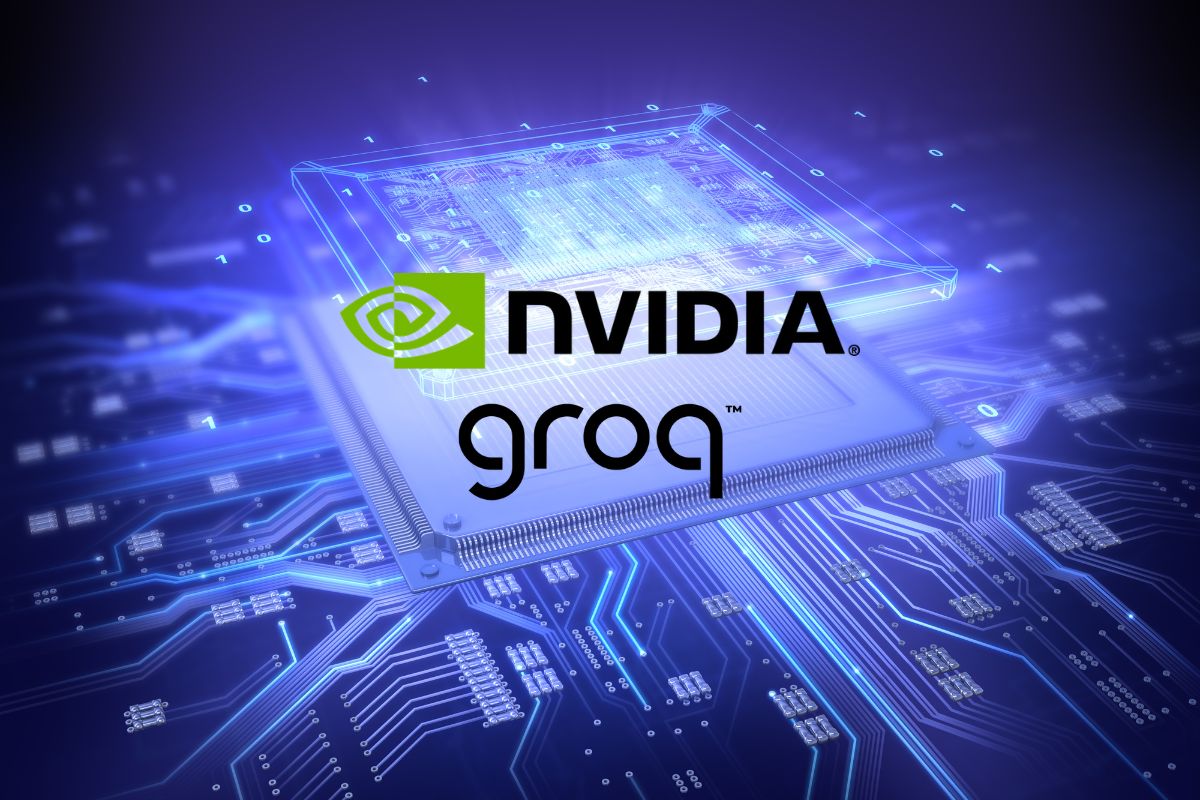
Nvidia has agreed to license chip technology from AI startup Groq and hire its chief executive, according to a blog post published by Groq on Wednesday. Groq’s CEO is a former executive at Alphabet’s Google, where he helped launch the company’s AI chip program.
The agreement reflects a growing trend among major technology firms, which increasingly secure access to promising technology and top talent through licensing and hiring arrangements rather than full acquisitions.
Nvidia targets AI inference as competition intensifies
Groq focuses on AI inference, the process that allows trained artificial intelligence models to respond to user requests. While Nvidia remains the dominant force in AI model training, the inference segment is far more competitive. Established rivals such as Advanced Micro Devices are pushing aggressively into the space, alongside specialized startups including Groq and Cerebras Systems.
Groq said Nvidia agreed to a non-exclusive license for its technology. As part of the deal, founder Jonathan Ross, Groq President Sunny Madra, and several senior engineers will join Nvidia. A source familiar with the matter confirmed the licensing arrangement.
Groq remains independent despite acquisition speculation
Financial terms of the agreement were not disclosed. Media reports had suggested Nvidia was considering a $20 billion cash acquisition of Groq, but neither company confirmed the claim. Groq said it will continue operating as an independent firm, with Simon Edwards serving as CEO, and its cloud business remaining fully active.
Big Tech increasingly favors licensing-and-hiring deals
Similar transactions have become common across the tech sector. Microsoft brought in a leading AI executive through a $650 million deal structured as a licensing arrangement, while Meta reportedly spent $15 billion to hire the CEO of Scale AI without acquiring the company itself. Amazon also hired founders from Adept AI, and Nvidia has pursued comparable deals this year.
Although these arrangements have attracted regulatory scrutiny, none have been reversed so far. Bernstein analyst Stacy Rasgon noted that antitrust risk remains the primary concern, though structuring the agreement as a non-exclusive license may help preserve the appearance of competition. He also pointed out that Nvidia CEO Jensen Huang maintains strong ties with the current U.S. administration.
Groq valuation surges as funding accelerates
Groq more than doubled its valuation to $6.9 billion, up from $2.8 billion in August last year, following a $750 million funding round completed in September. The company is among a group of AI chip startups that avoid external high-bandwidth memory, instead relying on on-chip SRAM. This approach reduces exposure to the global memory shortage and improves response speed for chatbots and AI applications, though it limits the size of models that can be served.
Cerebras remains Groq’s closest competitor using a similar architecture. Reuters recently reported that Cerebras may pursue an initial public offering as early as next year. Both companies have also secured major contracts in the Middle East.
During his largest keynote of 2025, Huang emphasized Nvidia’s confidence in maintaining its leadership position as AI workloads increasingly shift from training toward inference.