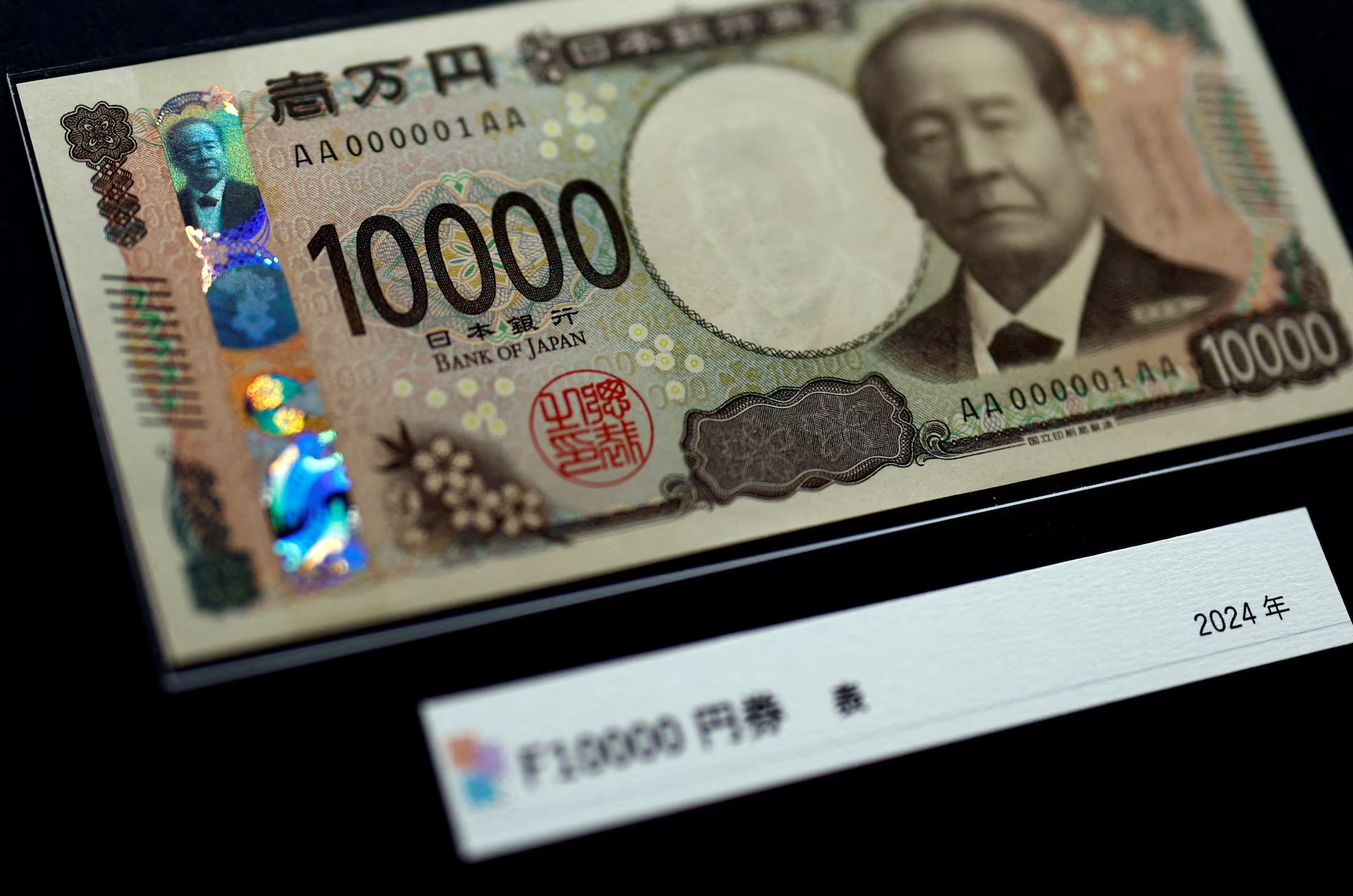
The Japanese yen fell sharply on Friday, weakening against the U.S. dollar and other major currencies after the Bank of Japan raised interest rates to their highest level in three decades but offered little guidance on the pace of future tightening.
The currency declined after the BOJ lifted its policy rate to 0.75% from 0.5%, a move that had been widely anticipated by markets. With the decision largely priced in, traders responded by selling the yen.
Losses deepened following BOJ Governor Kazuo Ueda’s press conference, where he avoided giving specifics on when or how quickly further rate hikes might occur. He reiterated that additional tightening remained possible, but provided no firm timeline.
The dollar climbed as high as 157.67 yen, its strongest level in four weeks and on track for the biggest one-day gain since early October. It was last trading up 1.23% at 157.535 yen.
The yen also weakened sharply against other major peers. The euro reached a record high of 184.71 yen, while the Swiss franc surged to an all-time high of 197.23 yen. Sterling rose as much as 1.36% to 210.96 yen, its strongest level since 2008.
Market strategists noted that the yen was the clear underperformer. Analysts said the BOJ’s decision, while expected, lacked a sufficiently hawkish tone to support the currency.
In its policy statement, the BOJ maintained its view that underlying inflation will move toward its 2% target during the latter part of its projection period through fiscal 2027. It emphasized that real interest rates remain “significantly” low even after the hike and reiterated its willingness to tighten further if economic and inflation trends align with forecasts.
Despite these assurances, the guidance failed to halt the yen’s decline.
Intervention risks return as yen slides
Traders have increasingly priced in the risk of official intervention after the yen breached the 155 level against the dollar in November.
The last time Japanese authorities intervened in currency markets was in July 2024, when dollar-yen surged to 161.96, its highest level since the mid-1980s.
Japanese Finance Minister Satsuki Katayama warned on Friday that Tokyo stands ready to act against excessive currency volatility. She said authorities would respond appropriately to sharp moves, including those driven by speculative activity.
Some analysts pushed back against the view that the BOJ’s stance was dovish, arguing that the threshold for further rate hikes remains low. They noted that the central bank highlighted continued wage growth and persistent inflation pressures, while also acknowledging that the policy rate remains below the lower end of the neutral range.
Euro steady, sterling volatile
The euro held firm at $1.1720 after European Union leaders agreed to borrow funds to support Ukraine’s defense over the next two years, avoiding the use of frozen Russian assets. The decision helped steady sentiment in the single currency.
European Central Bank President Christine Lagarde offered no forward guidance on Thursday and said all policy options remain open. The ECB kept interest rates unchanged at 2%, as expected.
Sterling fluctuated before settling near $1.3388 after the Bank of England cut interest rates to 3.75%. While the move was expected, the close vote suggested limited room for further easing.
The dollar briefly weakened overnight following an unexpected drop in U.S. inflation, but doubts over data reliability due to the government shutdown led the move to quickly reverse.
Elsewhere, the Australian dollar edged up 0.06% to $0.66175, while the New Zealand dollar slipped 0.23% to $0.57619. The dollar was little changed at 7.0342 against the offshore Chinese yuan.
In cryptocurrency markets, bitcoin rose 2.77% to $87,978.94, while ethereum climbed 5.73% to $2,991.88.