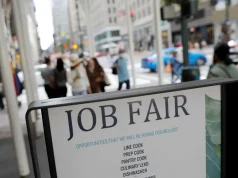
The U.S. economy created more jobs than expected in November, although the unemployment rate increased slightly faster than forecasts, according to data released Tuesday after a lengthy delay caused by a record federal government shutdown.
U.S. job growth beats expectations despite rising unemployment
Nonfarm payrolls rose by 64,000 in November, exceeding economists’ expectations of 50,000 jobs, according to figures from the Bureau of Labor Statistics (BLS). The gain followed a revised loss of 105,000 jobs in October.
The BLS said employment growth was supported by gains in healthcare and construction, which partially offset a decline of 6,000 federal government jobs. That followed a steep loss of 162,000 government positions in October.
Shutdown impact clouds payroll data
Economists at Goldman Sachs had anticipated a significant drag from a deferred resignation program for federal employees under the Department of Government Efficiency. However, they noted that while the program remains a key uncertainty for payroll figures, it may not accurately reflect broader labor market conditions.
The unemployment rate edged up to 4.6% in November, above expectations of 4.5%, marking its highest level in more than four years. The rise has reinforced concerns that the U.S. labor market may be losing momentum.
October payroll figures were not released at the time due to a data blackout linked to the 43-day government shutdown and were partially incorporated into the November report. As a result, the unemployment rate for October will never be published, leaving a permanent gap in a closely watched data series.
The BLS cautioned that it is not possible to precisely measure how the shutdown affected November’s household survey. The report was delayed because data collection began late, and additional time was required to contact households around the Thanksgiving holiday.
Revisions and Fed policy implications
The BLS also revised earlier data, cutting job losses in August by 22,000 to 26,000 and lowering September job gains to 108,000. Combined employment for August and September is now 33,000 lower than previously reported.
These updated labor market figures are seen as critical for assessing the future path of Federal Reserve interest rate policy. Fed officials did not have access to jobs data for October or November when they made their most recent rate decision and instead relied on alternative indicators pointing to gradual weakening in employment.
Last week, the Federal Reserve cut interest rates by 25 basis points, citing a need to support slowing job growth while inflation pressures remain elevated but stable.
Market analysts said the latest data could reinforce expectations for a more accommodative policy stance. Some noted that the jobs report may be modestly supportive for equities, as it suggests continued policy flexibility without significantly increasing growth concerns.
Retail sales and consumer spending outlook
Separate data from the U.S. Census Bureau showed that retail sales were flat in October, following a modest 0.1% increase in September. Economists had expected another 0.1% rise.
Retail performance has been mixed, with some large chains reporting strong results ahead of the holiday season, while others cited weaker consumer demand as households remain cautious due to elevated inflation.
Analysts at Capital Economics said the flat reading was largely driven by lower vehicle sales after electric vehicle incentives introduced during the Biden administration were phased out. They added that while consumer spending likely slowed in the fourth quarter, the data may overstate the extent of the downturn.
Consumer spending remains a key driver of the U.S. economy, accounting for more than two-thirds of total economic activity.