Asia Stocks Slip as Traders Assess Fragile U.S.-China Truce; RBA Holds Rates Steady
Asian markets traded mostly subdued on Tuesday as investors evaluated a fragile U.S.-China trade truce and renewed technology tensions, while Australian shares remained lower after the Reserve Bank of Australia (RBA) held interest rates steady as expected.
Regional sentiment was cautious, with South Korea’s KOSPI leading losses following a sharp record-setting rally in recent weeks. Meanwhile, Wall Street ended mixed overnight, with gains in tech stocks after Amazon and OpenAI announced a $38 billion cloud deal.
By 04:10 GMT, U.S. stock futures edged lower during Asian trading hours, reflecting ongoing investor uncertainty over global policy developments.
RBA Keeps Rates Unchanged Amid Inflation Pressures
The Reserve Bank of Australia left its cash rate unchanged at 3.60%, in line with market expectations. Policymakers balanced concerns about rising inflation with signs of a recovering domestic economy and global uncertainty.
Traders examined the RBA’s statement for signals on when rate cuts might begin in 2026, though the central bank offered little new guidance. The RBA maintained a cautious stance, citing persistent price pressures and a slightly tight labor market.
Australia’s S&P/ASX 200 index held around 0.7% losses after the decision, as the outcome had already been priced in by markets.
U.S.-China Tech Tensions Resurface After Trade Truce
Despite a recent truce, U.S.-China technology tensions remained in focus. President Donald Trump said in a “60 Minutes” interview on Monday that Nvidia’s advanced Blackwell AI chips would be kept for U.S. use only, not exported to China — reinforcing ongoing export restrictions.
Meanwhile, Chinese Ambassador Xie Feng urged Washington to respect Beijing’s “red lines” following the Trump-Xi summit in South Korea, where both sides agreed to a one-year trade and technology truce and to resume high-level dialogue on security and commerce.
Xie described the deal as a “recalibration” of relations but warned that tensions could quickly return if core Chinese interests, such as Taiwan and human rights, were challenged.
Investors remained wary about the durability of the truce, noting that deep structural differences between the world’s two largest economies remain unresolved.
Asian Markets Mixed; KOSPI Leads Declines
Across the region, Asian stock markets traded cautiously.
- China’s CSI 300 index fell 0.5%, while the Shanghai Composite dipped 0.3%.
- Hong Kong’s Hang Seng was largely unchanged.
- Japan’s Nikkei 225 dropped 0.5% after reopening from a holiday, while the TOPIX index was flat.
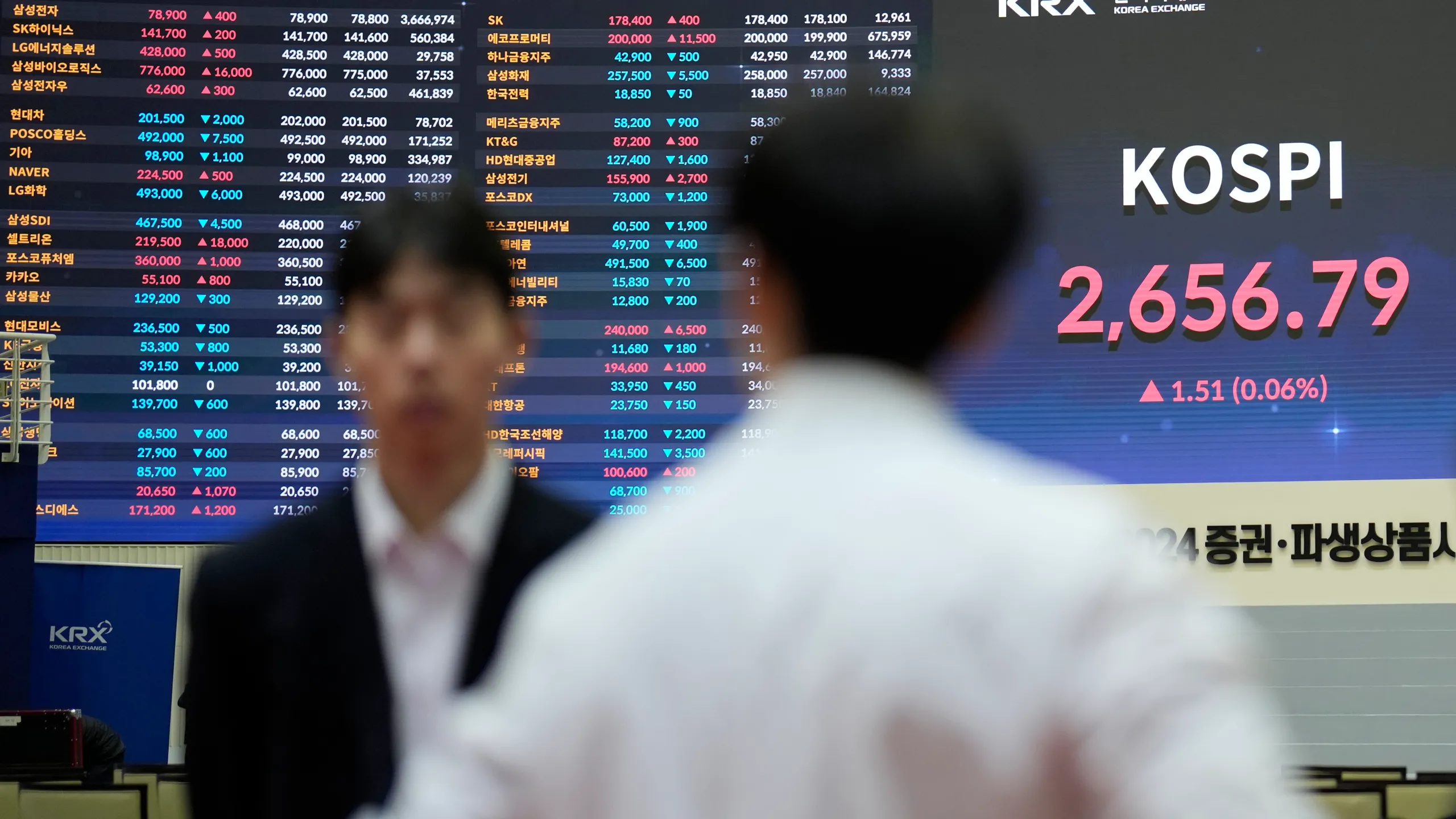
- South Korea’s KOSPI led regional losses, sliding nearly 2% after its recent record highs.
- Singapore’s Straits Times index was steady, while India’s Nifty 50 edged 0.2% lower.
Overall, Asian shares remained under pressure, with traders cautious amid U.S.-China trade uncertainty, rising inflation risks, and central bank caution across key economies.