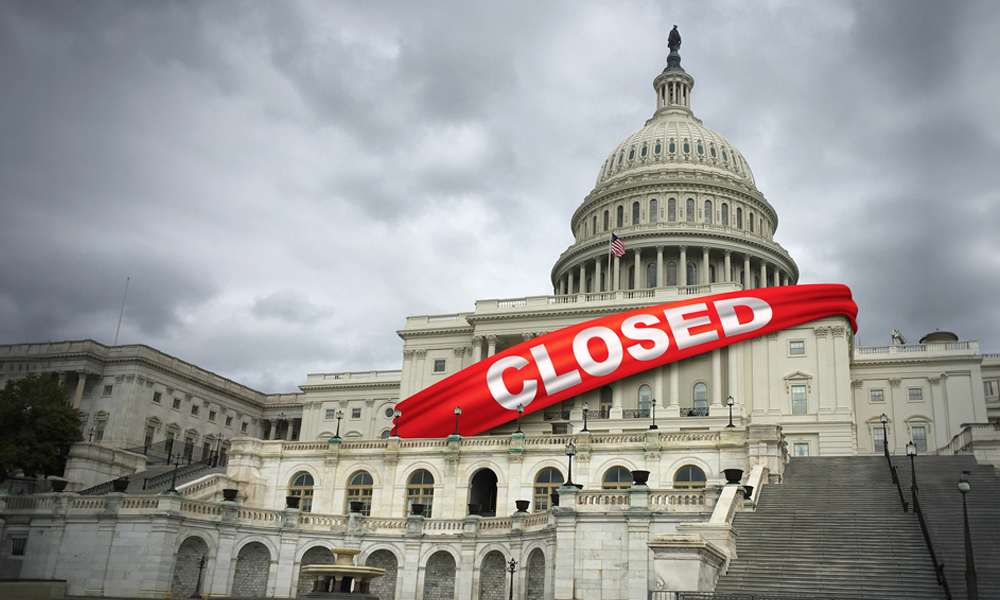
U.S. President Donald Trump and Democratic leaders made little progress during a White House meeting aimed at preventing a government shutdown that could disrupt services nationwide as early as Wednesday.
Both sides left the meeting blaming each other if Congress fails to pass a funding bill before Tuesday’s midnight deadline (0400 GMT Wednesday). Vice President JD Vance said bluntly: “I think we’re headed to a shutdown.”
Democrats argue that any deal to extend funding must also protect health benefits set to expire. Republicans, led by Trump, insist that healthcare and government spending should be handled separately. Senate Democratic Leader Chuck Schumer admitted the two sides still have “very large differences.”
If Congress fails to act, thousands of federal employees could be furloughed, affecting agencies from NASA to national parks. Federal courts could shut down, and small business grants may be delayed. Budget standoffs have become common in Washington over the past 15 years, but Trump’s willingness to override spending laws has added new uncertainty.
Trump has already withheld billions approved by Congress and has threatened to expand his purge of the federal workforce if a shutdown occurs. Only a few agencies have outlined contingency plans. Meanwhile, the White House issued an executive order to extend over 20 federal advisory committees through 2027, though their funding remains uncertain.
At the heart of the dispute is $1.7 trillion in discretionary spending, which funds about one-quarter of the $7 trillion federal budget. Democrats proposed a short-term extension of seven to 10 days, while Republicans pushed for a longer stopgap through November 21. Schumer rejected the shorter plan, and Senate Republican Leader John Thune has scheduled a vote on the GOP proposal, which has already failed once.
Since 1981, there have been 14 partial shutdowns, most lasting only days. The longest, in 2018-2019 during Trump’s first term, stretched 35 days due to an immigration dispute. This time, the fight centers on healthcare. Roughly 24 million Americans could see higher costs if temporary tax breaks under the Affordable Care Act expire. House Democratic Leader Hakeem Jeffries argued those breaks must be made permanent, as insurers finalize premiums ahead of the November 1 enrollment period.
Republicans say they are open to discussing healthcare but not as part of a short-term spending patch. Vance acknowledged that both sides had reasonable ideas but criticized Democrats for using healthcare as leverage. Democrats, meanwhile, see the issue as a way to energize their base ahead of the 2026 midterm elections. Still, some aides worry a shutdown could backfire politically if Democrats appear to oppose Trump for its own sake rather than present clear solutions.