Asia stocks rally with Japan, Korea at record highs; China slips on chip tensions
Asian stock markets mostly extended gains on Tuesday, with Japan and South Korea hitting fresh record highs, supported by expectations of a U.S. Federal Reserve interest rate cut this week.
In contrast, Chinese equities retreated from decade highs as investors turned cautious amid renewed U.S.–China tensions over chip exports.
The rally in Asia followed record closes for the S&P 500 and Nasdaq overnight, while U.S. stock futures traded flat in early Asia hours.
Japan and South Korea surge to new peaks
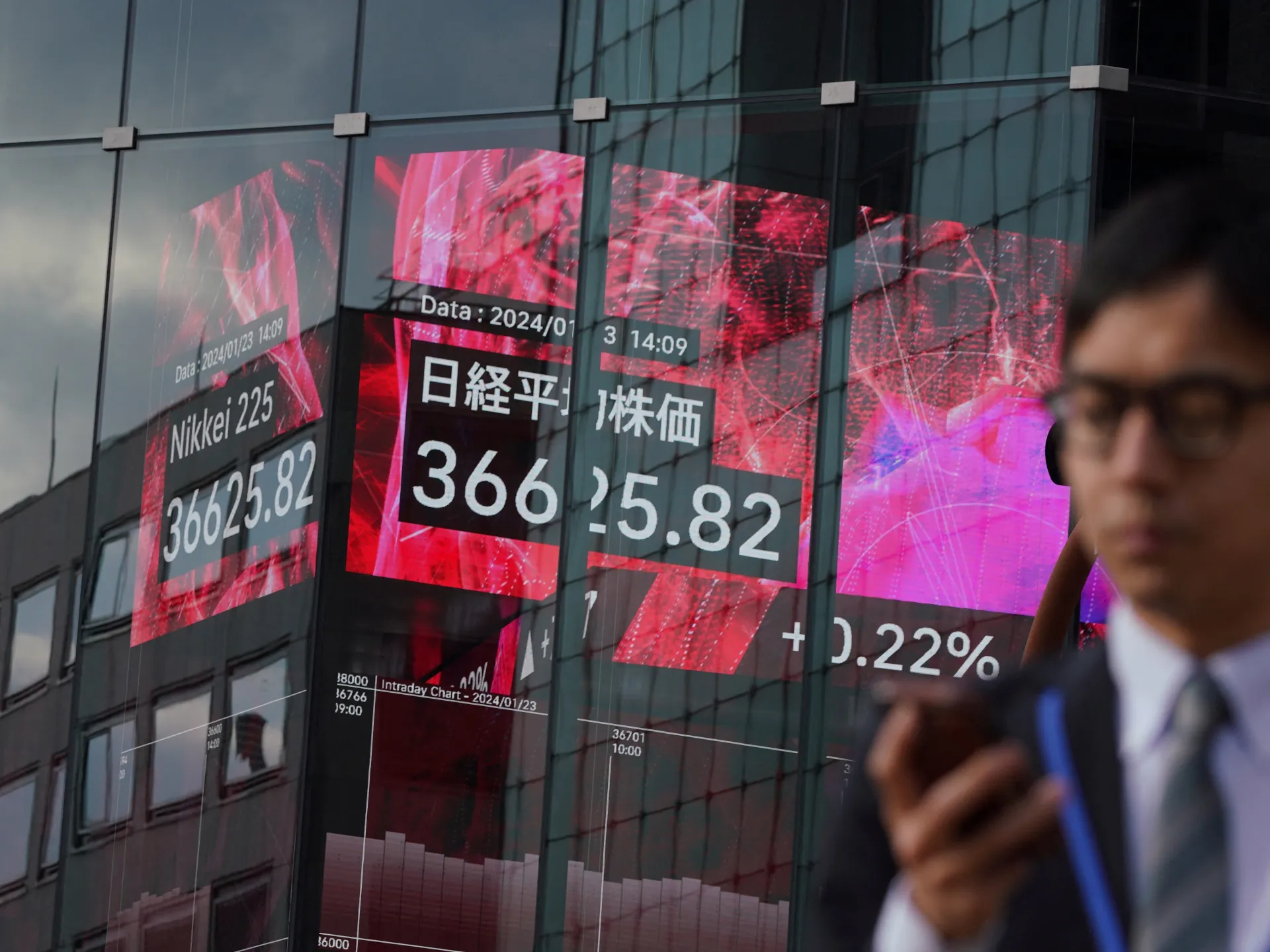
Japan’s Nikkei 225 climbed 0.6% to a record 45,055.38, driven by gains in technology and industrial stocks. The broader TOPIX rose 0.5% to a new high of 3,177.20. South Korea’s KOSPI jumped 1.3% to a record 3,452.50, lifted by Samsung Electronics and SK Hynix.
Markets are largely pricing in a 25-basis-point Fed cut this week, with equities buoyed by the outlook for easier financial conditions.
Elsewhere in the region, Australia’s S&P/ASX 200 gained 0.2%, Singapore’s Straits Times Index was flat, and India’s Nifty 50 edged up 0.2% at open. India faces export pressures from higher U.S. tariffs, with trade talks in New Delhi expected to address frictions.
U.S.–China talks steady sentiment, but chip worries weigh on China
Progress in U.S.–China negotiations in Madrid also supported sentiment. Treasury Secretary Scott Bessent confirmed a framework deal on TikTok’s U.S. ownership and noted that China dropped tariff concessions, while Washington secured security guarantees. Presidents Donald Trump and Xi Jinping are expected to finalize details later this week.
Still, caution returned after Chinese regulators said Nvidia (NASDAQ: NVDA) violated anti-monopoly rules. Meanwhile, U.S. officials defended restrictions on semiconductor exports to China as necessary for national security, which Beijing’s top negotiator Li Chenggang denounced as “unilateral bullying.”
China’s CSI 300 slipped 0.4% from near three-year highs, while the Shanghai Composite eased 0.2%. Hong Kong’s Hang Seng Index was little changed.