Trump Pressures Powell on Rates During Rare Visit to the Fed Headquarters
President Donald Trump clashed with Federal Reserve Chair Jerome Powell on Thursday during an unusual presidential visit to the U.S. central bank, where he criticized the soaring costs of a $2.5 billion renovation project and renewed his calls for significant interest rate cuts.
Despite labeling Powell a “numbskull” earlier in the week over his resistance to large rate reductions, Trump clarified after the visit that he did not currently intend to remove him from the position, a threat he has made in the past.
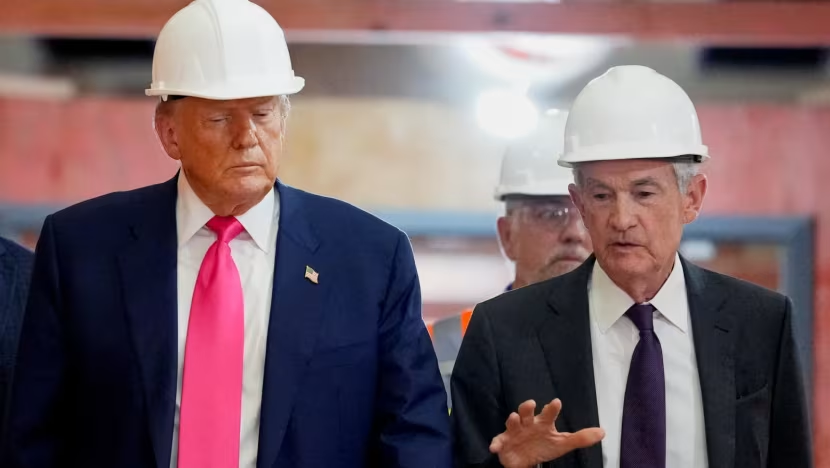
“That would be a big step, and I just don’t think it’s necessary,” Trump told reporters after touring the Fed’s Washington headquarters, where renovations are underway on two historic buildings.
Later, in a post on his Truth Social platform, Trump remarked: “It is what it is and, hopefully, it will be finished ASAP. The cost overruns are substantial but, on the positive side, our Country is doing very well and can afford just about anything.”
The tense exchange at the construction site underscored the mounting pressure the White House is placing on the central bank ahead of next week’s key Federal Open Market Committee meeting, where policymakers are widely expected to hold interest rates steady at between 4.25% and 4.50%. Trump has repeatedly demanded a dramatic rate cut of at least three percentage points.
“I’d love him to lower interest rates,” Trump said at the end of the visit, with Powell standing silently beside him.
Normally, Powell spends the Thursday before each policy meeting holding private calls with regional Fed presidents to prepare. But on this day, he was drawn into a public confrontation. Tensions rose further when Trump challenged the cost estimate for the renovation, claiming it had ballooned to $3.1 billion. Powell, appearing surprised, replied, “I’m not aware of that,” then reviewed a document Trump handed him, pointing out that it mistakenly included a third building that had been renovated five years prior.
Joining Trump at the site were White House budget director Russell Vought and deputy chief of staff James Blair, both vocal critics of the renovation project. They questioned the oversight of the work and suggested potential financial mismanagement. Senate Banking Committee Chair Tim Scott also attended the visit, having sent Powell a letter the day before seeking answers about the project’s spending.
Powell, originally appointed by Trump in 2018 and later reappointed by President Joe Biden, last met with the current president in March when Trump summoned him to the White House to advocate for rate cuts.
Thursday’s visit comes as Trump seeks to shift attention from a political firestorm related to the administration’s refusal to release documents tied to the late Jeffrey Epstein, despite having promised transparency during his campaign.
According to the Fed, the building project—its first full renovation in nearly a century—has encountered unanticipated challenges, including toxic material removal and rising costs for materials and labor. Public documents posted online emphasize that security upgrades, such as blast-resistant windows, as well as tariffs, have significantly driven up expenses.
Reporters on site were shown around the facilities, with Fed staff pointing out that rooftop garden seating—criticized by some lawmakers—had been removed to avoid the perception of luxury. A planned fountain was also scrapped, marking one of only two changes to the original renovation design.
The project began in mid-2022 and is expected to be completed by 2027, with the Fed aiming to reoccupy the buildings by March 2028.
Despite the high-profile visit and rhetoric, financial markets remained calm. The S&P 500 closed flat, while 10-year Treasury yields ticked up slightly after a drop in weekly jobless claims suggested continued strength in the labor market—reducing pressure on the Fed to cut rates.
Trump’s ongoing criticism of Powell and his repeated threats to interfere with central bank leadership have raised concerns about undermining the Fed’s independence—an institution traditionally shielded from political influence. His visit stands in contrast to previous presidential interactions with the Fed, such as FDR’s 1937 dedication of the headquarters and George W. Bush’s 2006 attendance at Ben Bernanke’s swearing-in.