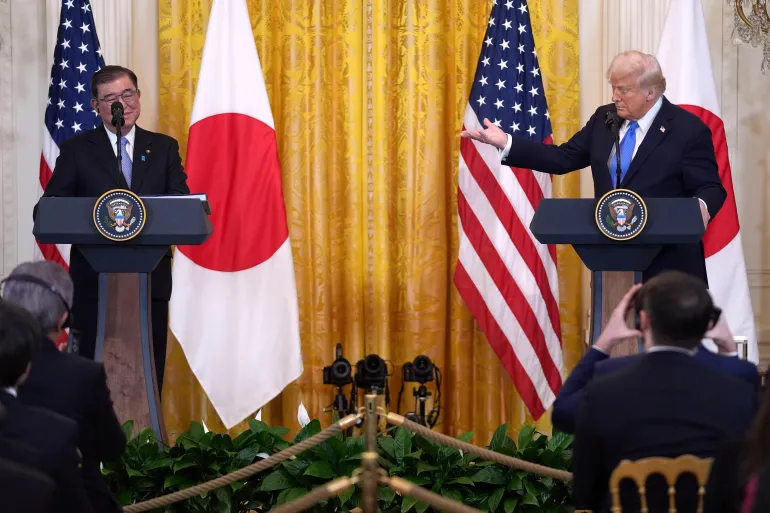
U.S. President Donald Trump announced Wednesday that his administration has finalized a “massive” trade agreement with Japan, which will subject Japanese exports to a 15% tariff.
Trump also stated that Japan has committed to investing $550 billion in the U.S., claiming that the United States will receive 90% of the profits from that investment.
In a post on social media, Trump said: “Japan will open its markets to U.S. goods—including cars, trucks, rice, and various agricultural products—and apply reciprocal 15% tariffs on exports to the U.S.”
The announcement follows news that Japan’s chief trade negotiator, Ryosei Akazawa, met with Trump at the White House on Tuesday.
While the agreed 15% tariff is lower than the 25% Trump initially proposed, it still falls short of Japan’s request for a full exemption from U.S. tariffs. The new levy is expected to take effect on August 1, aligning with the implementation of Trump’s other reciprocal tariffs targeting several major economies.
Speculation around the trade deal had intensified earlier in the week, particularly after Prime Minister Shigeru Ishiba’s ruling party suffered a significant defeat in Japan’s upper house elections over the weekend, casting doubt over Japan’s negotiating leverage.
It remains unclear whether the 15% tariff will be added on top of Trump’s existing 25% tariff on automobiles and 50% on steel—two contentious areas for Japan, as autos and steel are key exports to the U.S.
According to NHK, Japanese automakers will be hit with 15% tariffs on vehicle exports to the U.S. While major manufacturers like Toyota (NYSE: TM) and Honda (NYSE: HMC) operate factories in the U.S., they still export several models and components, and the tariffs are expected to raise the retail price of their vehicles. Both companies saw their shares jump sharply in Tokyo trading on Wednesday.
Trump has emphasized that these tariffs are part of a strategy to bring manufacturing back to the United States. However, analysts and the Federal Reserve have warned that such tariffs could fuel inflation, as domestic importers—and ultimately consumers—bear the brunt of higher costs.