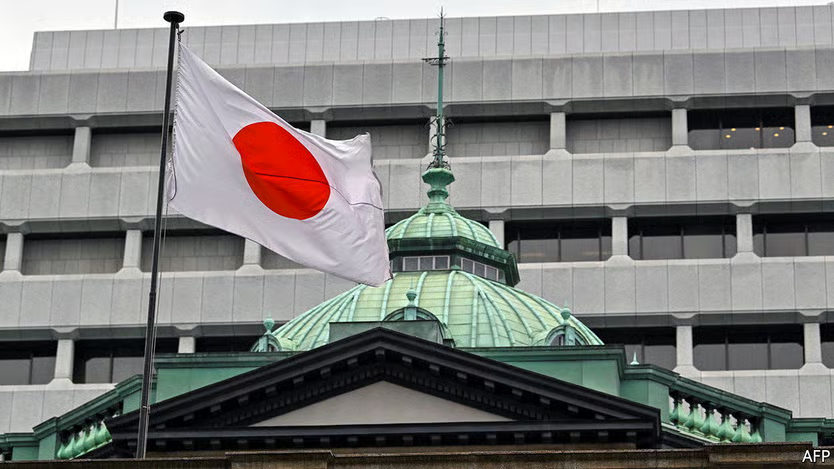
Japan’s recent trade agreement with the U.S. has helped ease economic uncertainty, said Bank of Japan Deputy Governor Shinichi Uchida, expressing optimism that conditions may be aligning for a possible resumption of interest rate hikes.
Uchida’s comments followed U.S. President Donald Trump’s announcement of a new trade deal with Tokyo, which reduces tariffs on Japanese car exports and spares Japan from additional duties on other products.
“This is a significant step forward that helps reduce uncertainty for Japan’s economy,” Uchida stated on Wednesday, noting that the Bank of Japan (BOJ) will factor the deal into its upcoming growth and inflation forecasts at its July 30–31 policy meeting.
He added that with uncertainty fading, “the probability of Japan sustainably reaching its 2% inflation target has increased.”
BOJ officials have consistently emphasized the need for more compelling evidence that inflation will stay above target before raising interest rates further. Uchida acknowledged there’s still some ambiguity about the broader economic impact of tariffs, both domestically and globally, but said the BOJ is carefully weighing both upside and downside risks.
Speaking to business leaders in Kochi, Uchida said the BOJ must fine-tune monetary policy to best manage economic and price stability, reiterating that the bank will continue with rate hikes if data supports their forecasts.
According to sources cited by Reuters, the BOJ’s upcoming quarterly report will still reflect concern over the effects of U.S. tariffs, but the outlook is expected to be less pessimistic than the previous quarter, when market volatility was at its peak.
Uchida said the trade deal offers major relief to Japanese companies and, combined with labor shortages, could lead to continued wage increases.
The BOJ anticipates that core inflation, driven by domestic demand, will reach its 2% goal sometime between late fiscal 2026 and 2027, Uchida noted.
While speculation about Prime Minister Shigeru Ishiba’s possible resignation could fuel fresh political instability, some analysts believe the removal of trade-related risks makes a BOJ rate hike more likely by year-end.
“This trade agreement removes a major downside risk for Japan’s economy,” said Marcel Thieliant, head of Asia-Pacific at Capital Economics. “Although Ishiba’s potential resignation adds political uncertainty, we now see a higher chance of a rate hike before year-end.”
A Reuters survey showed that most economists expect the BOJ to raise interest rates again by the end of 2025, though few predict action at the upcoming July meeting.
Inflation Running Hotter Than Anticipated
After ending its ultra-loose monetary policy last year, the BOJ raised short-term interest rates to 0.5% in January, believing the country was on track to meet its 2% inflation goal in a sustainable way.
While the central bank has signaled willingness to raise rates further, it scaled back its growth forecasts in May, citing uncertainty tied to U.S. trade policies.
Adding complexity to the BOJ’s policy outlook, core consumer inflation has remained above 2% for over three years, with rising food costs placing pressure on households.
Uchida noted that inflation is stronger than the BOJ had projected, especially with food price increases extending beyond basic staples like rice. This trend, he said, points to a shift in how companies are setting prices, which could shape public expectations about future inflation.
The BOJ will monitor how these pricing trends influence underlying inflation as it determines its next policy moves, Uchida added.