Trump Leaves G7 Summit Early Amid Middle East Crisis; Offers Ceasefire Proposal
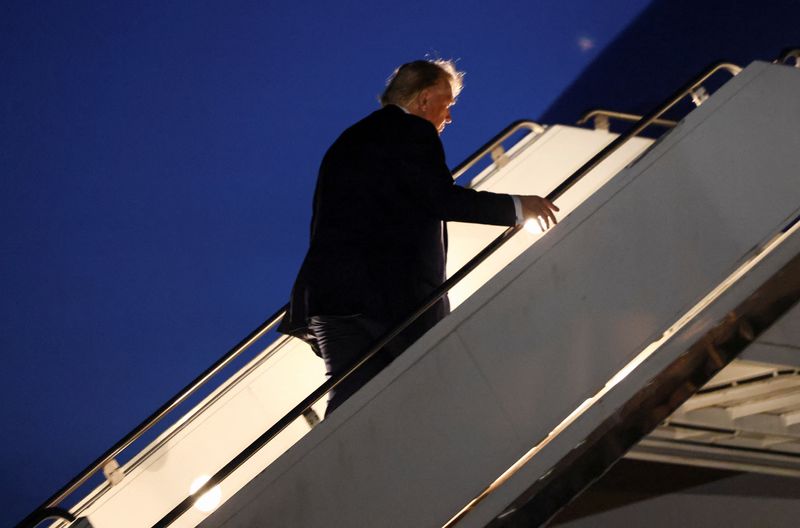
U.S. President Donald Trump departed the Group of Seven summit in Canada a day ahead of schedule due to escalating tensions in the Middle East, according to a statement from the White House on Monday.
French President Emmanuel Macron confirmed that Trump had proposed a ceasefire between Israel and Iran. The move followed Trump’s earlier call for the immediate evacuation of Tehran and his renewed criticism of Iran’s refusal to sign a nuclear agreement with the U.S.
“Significant progress was made, but given developments in the Middle East, President Trump will leave tonight after the leaders’ dinner,” said White House Press Secretary Karoline Leavitt in a post on X.
The G7 has faced challenges maintaining a united front on global conflicts, particularly in Ukraine and the Middle East, as Trump has publicly supported Russian President Vladimir Putin and imposed tariffs on many of the participating allies.
Despite tensions, Trump did endorse a joint statement calling for a de-escalation in the Israel-Iran conflict. “We hope that resolving the Iran crisis will lead to broader regional calm, including a ceasefire in Gaza,” the G7 statement read.
The group reiterated support for Israel’s right to defend itself and described Iran as a destabilizing force in the region.
Macron described Trump’s early exit as potentially helpful in advancing ceasefire efforts. “There is indeed an offer on the table to engage, with the goal of achieving a ceasefire and opening broader negotiations,” Macron told reporters. “The next step is to see whether the parties will respond.”
The summit, held in the mountain resort of Kananaskis, included leaders from the U.S., U.K., Canada, France, Germany, Italy, Japan, and the European Union, and was scheduled to conclude on Tuesday.
Earlier in the summit, standing beside Canadian Prime Minister Mark Carney, Trump criticized the 2014 decision to expel Russia from the then-Group of Eight following the annexation of Crimea.
“That was a serious mistake,” Trump said, asserting that Russia might not have invaded Ukraine in 2022 if it had remained in the group. “Putin talks to me—he doesn’t talk to the others. He basically ignores those who kicked him out, and I agree with him,” Trump added.
Though he did not explicitly call for Russia’s return to the G7, Trump’s comments cast doubt on what Ukrainian President Volodymyr Zelenskiy might accomplish when he joins the summit on Tuesday. European leaders had hoped to secure Trump’s support for stricter sanctions against Moscow.
A spokesperson from Ukraine’s embassy in Canada confirmed that Zelenskiy still planned to attend the summit.
To avoid a repeat of the contentious 2018 summit—where Trump revoked U.S. support for the final communique—Canada has opted not to pursue a comprehensive joint statement this time.
Instead, leaders drafted several topic-specific documents covering migration, artificial intelligence, and critical minerals. However, none have received formal approval from the U.S., sources familiar with the matter said. One European diplomat noted that it remained unclear whether any final declarations would be issued without Trump’s endorsement.
Host Prime Minister Mark Carney extended invitations to several non-G7 nations, including Mexico, India, Australia, South Africa, South Korea, Brazil, and Ukraine.
Trade and Tariffs Take the Stage
Trump and British Prime Minister Keir Starmer announced on Monday that they had finalized a bilateral trade agreement, making the U.K. the first country to secure lower tariffs from the U.S. under Trump’s second term.
Carney later said he and Trump had agreed to try finalizing a broader economic and security agreement within 30 days.
Trump also expressed interest in striking a new deal with Canada but emphasized that tariffs must remain part of the framework—a stance strongly opposed by Ottawa.
“Our position is clear: there should be no tariffs on Canadian exports to the U.S.,” said Kirsten Hillman, Canada’s ambassador to Washington.