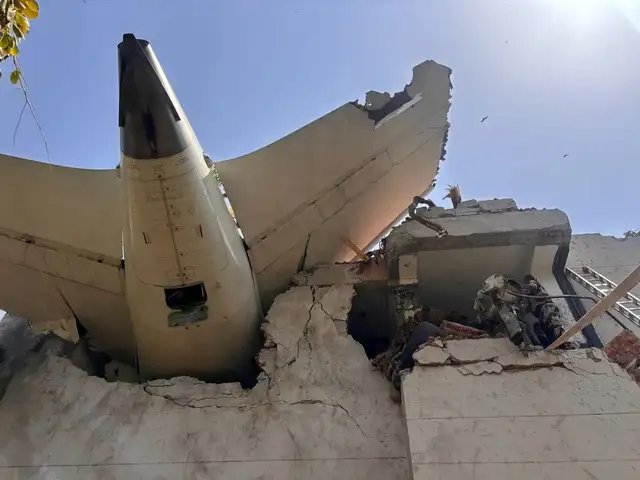
The crash of an Air India 787-8 Dreamliner shortly after takeoff on Thursday marks a serious blow to Boeing (NYSE:BA), as its new CEO works to restore confidence following ongoing safety and manufacturing setbacks.
The tragedy, which claimed the lives of most of the 242 people onboard, casts a shadow over the Dreamliner’s safety reputation just ahead of next week’s Paris Airshow. It also complicates CEO Kelly Ortberg’s efforts to ramp up production, despite Boeing recently meeting key output goals in May.
Boeing shares dropped around 4.8%, trading at $203.55, after falling as much as 8% in pre-market trading. The company acknowledged the reports and said it is gathering more information.
The aircraft, en route to London, crashed near Ahmedabad in western India, in what authorities are calling the worst aviation disaster globally in the past ten years. The cause remains unknown.
Prior to the incident, airline executives had shown growing confidence in Boeing’s recovery and Ortberg’s leadership, particularly following years of reputational damage. Optimism was evident at a recent industry summit in New Delhi, where participants discussed Boeing’s improving track record on safety and regulation.
Until this crash, the 787 Dreamliner—one of the most advanced widebody jets—had not experienced a fatal accident. The aircraft was briefly grounded in 2013 due to battery issues, though no injuries occurred during those events.
In contrast, Boeing’s 737 MAX series faced prolonged global grounding after two deadly crashes and has continued to struggle with production and safety scrutiny. The spotlight returned in 2023 when a door plug detached mid-flight from a 737 MAX 9, prompting another FAA grounding and fresh questions about quality control.
Suppliers were also impacted: shares of Spirit AeroSystems (NYSE:SPR) and GE Aerospace, the jet’s engine manufacturer, both dipped around 2%.
GE Aerospace stated that its emergency response team has been activated and pledged to assist the investigation, although it did not confirm whether its engines were on the crashed aircraft. The company has not responded to media inquiries.
“This appears to be a knee-jerk market reaction, reigniting concerns over Boeing’s ongoing troubles,” said Chris Beauchamp, an analyst at IG Group.
Boeing’s debt also saw slight selling pressure. Its bonds maturing in May 2029 widened by 10 basis points, trading at 88 basis points over comparable U.S. Treasuries, according to a bond market source.