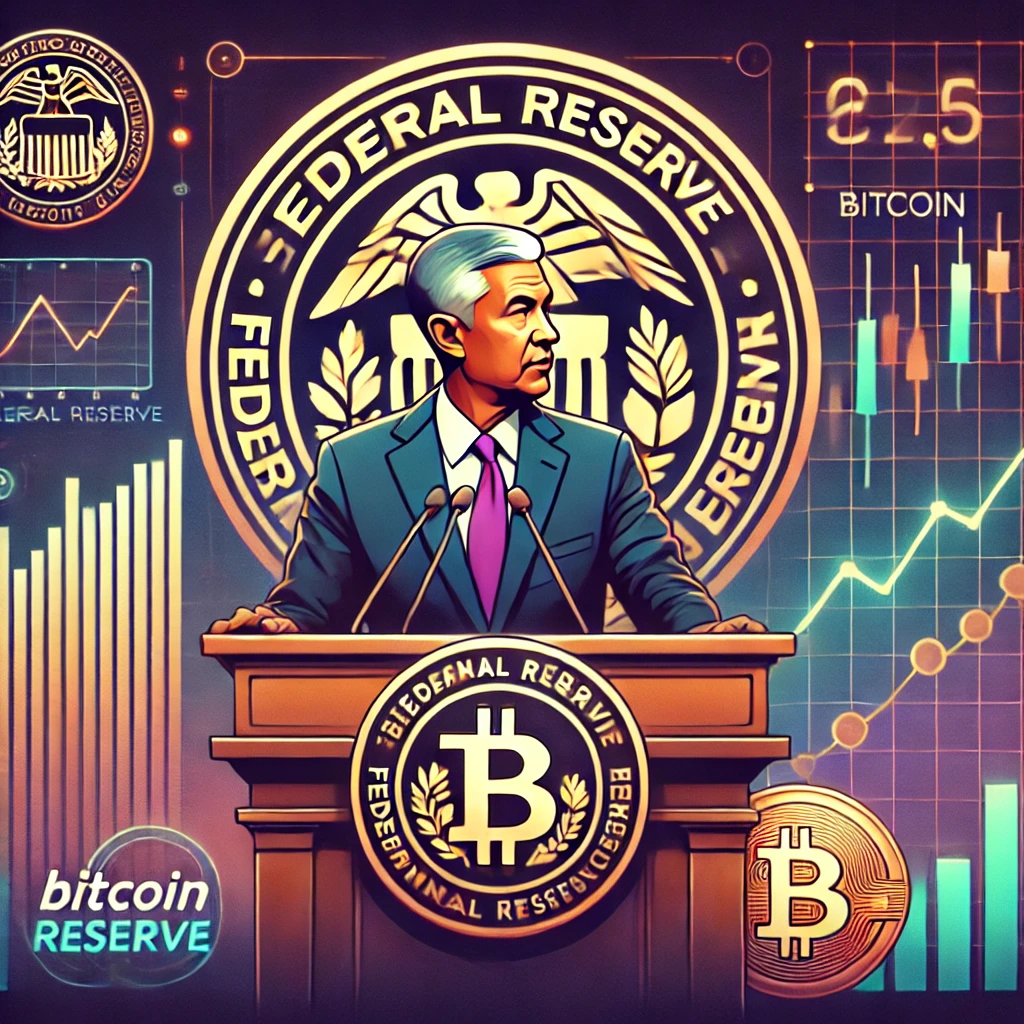
Fed Implements 0.25% Rate Cut as Jerome Powell Signals Uncertainty in Future Decision
Highlights:
- Fed Chair Jerome Powell hints at less restrictive policies in the months ahead.
- Confidence expressed in the U.S. economy and recovery efforts.
- Remarks on a Bitcoin reserve plan create market turbulence.
For the third time this year, the Federal Reserve, led by Chair Jerome Powell, has enacted a 0.25% interest rate cut, lowering the Fed funds rate to a range of 4.25% to 4.5%. Powell emphasized the balanced risks to achieving employment and inflation targets, projecting stability for the U.S. economy.
Powell’s Outlook on Interest Rates
Jerome Powell acknowledged ongoing inflationary and employment challenges but expressed confidence in the economy’s overall expansion and the Fed’s policies bringing inflation closer to the 2% target. Despite this optimism, Powell highlighted that future rate cuts lack a defined pace. Decisions will depend on evolving economic data and assessments by the Federal Open Market Committee (FOMC).
The Fed initiated its first rate cut of the year in September with a 50 bps reduction, followed by a 0.25% cut in November, and now another 0.25% decrease. Powell suggested a potential slowdown in future rate adjustments while underscoring the importance of data-driven decision-making.
Crypto Market Reacts to Powell’s Speech
Jerome Powell’s comments introduced uncertainty to the cryptocurrency market. Bitcoin fell 3.91% in the past 24 hours, trading at $101,341, while altcoins like Ethereum (ETH), XRP, and Solana (SOL) experienced declines of 5.35%, 9.91%, and 7.23%, respectively.
Adding to the market unease, Powell dismissed the Federal Reserve’s ability to establish a Bitcoin strategic reserve, which undermined confidence in related plans. While the Trump administration has not released a detailed proposal for such a reserve, efforts in that direction are reportedly underway.
This mix of optimism, uncertainty, and crypto-specific remarks has kept markets on edge as investors look for clarity on both the Fed’s policies and broader economic conditions.